
Between Classical Composition, Jazz, and Brazilian Music: My Musical Education at Unicamp

What happens when a student’s most important questions do not fit entirely within the program they entered?
When I entered Unicamp at eighteen, I did not yet know exactly what my professional path would be, but one thing was already clear: I wanted to compose. I had begun writing my own pieces at around fifteen and was deeply interested in the process of imagining music and projects, then finding ways to bring them to life through writing and musical practice. For that reason, entering a Composition program rather than a performance program was a natural choice.
My listening, however, extended far beyond a single tradition. I listened to artists connected to Brazilian music and jazz, such as Hermeto Pascoal, John Coltrane, and Duke Ellington; composers from the concert music tradition, such as Mozart, Bach, and Stravinsky; and soundtracks from major epic productions, including those by John Williams, Hans Zimmer, and Howard Shore. These references did not seem incompatible to me. In different ways, they all fed my curiosity about composition, orchestration, and music’s expressive possibilities.
The Composition program was rooted primarily in the concert music tradition, with particular attention to the compositional aesthetics of the twentieth and twenty-first centuries. Concert music itself was not new to me, but I was still relatively unfamiliar with some of its modernist and experimental currents, especially atonal and serial languages, spectral music, and other compositional approaches that gained a strong presence in academic settings over the course of the twentieth century. These languages sparked my curiosity as fields of study, but at that point they did not occupy a central place among the references that moved me artistically or inspired the music I wanted to write. The references that spoke to me most directly came primarily from jazz and Brazilian instrumental music, including the improvisational practices found in those repertoires, and they appeared across different programs, departments, and areas of the university.
I did not yet realize it, but my education at Unicamp would be shaped less by the choice of a single path than by my attempt to build connections among the possibilities I found around me.

When Questions Do Not Fit Existing Categories
The breadth of my interests soon influenced the choices I made during my undergraduate studies. I began taking courses in the Popular Music program, and over time that path led me to complete a second bachelor’s degree, this time as a saxophonist.
Classical composition and popular music occupied relatively independent areas within the academic structure. By moving between them, I encountered professors, musicians, repertoires, and practices that contributed in different ways to the education I was seeking.
I began to organize my path around this movement between areas. In each one, I sought knowledge and experiences that helped me develop different aspects of my work. This was how I began to build an education within the university itself that was not centered on a single program.
→ Read how this search later developed during my graduate studies in the United States: Blurred Distinctions: What My Doctoral Research Taught Me About Jazz, Concert Music, and Hybrid Musical Languages
An Ecosystem Where Everything Happened at Once
What shaped my education most was not any particular course, but the environment. Unicamp functioned as an ecosystem in which countless musical experiences coexisted.
The schedule itself left gaps between some classes. During those windows, students could practice their instruments, study, rehearse, and spend time with one another.
Near the Institute of Arts was a café with a small CD stand. It was run by Naná, a familiar figure among the students, who often played interesting recordings. Over pão de queijo, coffee, or juice, we listened to that music, talked about what we were studying, and shared discoveries with our peers.
Those conversations helped shape our references, brought together students from different years and programs, and circulated music that might not have appeared in the courses we were taking. Part of our education happened precisely in those intervals, even when the encounters had no defined purpose.
Parties were also part of this musical life. Students formed bands, prepared repertoire, and played for their peers. Music existed alongside conversation, flirting, and social life in an environment very different from classrooms and formal concerts.
During my first year, as part of the activities welcoming new students, some upper-level students took us to one of the student houses. A band formed by students from more advanced cohorts had prepared an unusual, demanding, and at times highly virtuosic repertoire. I remember being genuinely captivated by the creativity of those musicians in an informal performance organized outside the academic program.
Some of those musicians later became collaborators in other projects and artists with whom I still share a musical affinity. One of them is Emiliano Sampaio, whose path has points of contact with mine, especially through the experience of studying abroad, working with big bands and other large ensembles, and exploring closely related subjects in our academic research. His career is only one example of the artistic relationships that began in that environment and continued to develop in the years that followed.
Years later, while studying at the Frost School of Music and participating in the Henry Mancini Institute, I came to understand more clearly the value of those spaces for artistic creation that existed within the university but outside the formal structure of classes. At Frost, I encountered a more organized model, with pre-formed groups, defined programs, performance schedules, and experiences in rehearsal, recording, and production integrated into the students’ educational paths.
At Unicamp, this dynamic emerged differently. Much of the artistic activity that moved us most was not part of an institutional program designed to organize those experiences or promote student autonomy. Festivals such as FEIA, choro circles, parties, original-music groups, and student-organized performances extended what took place in the classroom. The university provided rooms, instruments, professors, peers, and freedom of movement, but it was the relative absence of formal artistic programming, combined with the presence of students eager to create and realize their own work, that ultimately produced favorable conditions for projects to emerge. This was the context in which I formed several of my groups. Projects began to exist when someone gathered the available resources and took the initiative to make them happen.
Both environments offered important possibilities, but through different paths: at Frost, these experiences were supported by a more organized structure; at Unicamp, many of them emerged from what the students themselves built in spaces not yet occupied by institutional programming.

That environment exemplified an enduring dimension of university education: an institution also shapes its students through the encounters it enables and the spaces they learn to occupy.
Campinas: The City as an Extension of the University
An important part of this education took place at the concerts I attended. Campinas had an active cultural life and regularly welcomed musicians whose work I admired. Their performances offered concrete examples of how an artist could build a career without being confined to a single musical tradition, a possibility that spoke directly to the work I wanted to develop.
Venues and institutions such as CPFL Cultura and SESC played an important role in this process, regularly presenting artists who broadened our musical horizons and revealed possibilities that rarely appeared so clearly within academic divisions.
For many students, musical education did not end when classes were over. It continued through concerts, workshops, festivals, and encounters across the city.
I remember the impact that artists such as Benjamim Taubkin and the Orquestra Popular de Câmara, Hermeto Pascoal, Léa Freire, Mônica Salmaso, Nelson Ayres, and the group Pau Brasil had on me.
Through the curatorial choices of these venues, those concerts brought me into contact with a wide range of music being created especially in São Paulo and presented in Campinas. Looking back, I see that period as a particularly fertile moment for Brazilian music in the region. Rather than a dominant aesthetic, I encountered a rich diversity of projects, instrumental formats, and artistic paths. Many of those possibilities were new to me and expanded both my perspective and my musical curiosity.
It was also during this period that I came into contact with artists in residence from very different backgrounds, including Arrigo Barnabé, whose work continually challenged conventional categories and expectations.
Those experiences turned a still-abstract curiosity into possibilities I could observe in practice. The artists I followed did more than move among different musical languages. They had created groups, repertoires, and ways of working capable of sustaining their musical choices.
The First Creative Laboratories
Much of my education took place through the groups I created or joined. In my first year, I formed a Brazilian instrumental music quartet with three other students from my cohort. The pianist was a close friend with whom I had studied in high school and who had also played with me at the entrance audition for the program. I played saxophone, and the quartet was completed by bass and drums.
A few months after classes began, the university went on strike. We decided to continue meeting and began rehearsing almost every day in one of the group practice rooms. The room had a piano, drum set, and bass amplifier, everything we needed to work on the repertoire for hours at a time.
After a while, I began to notice that an upper-level student would occasionally come into the room and listen to part of our rehearsals. It was bassist Danilo Penteado, who was completing his studies at Unicamp and was a member of Quatro a Zero, a choro group formed by musicians from the Popular Music program that had won second place in the 7th Visa Award for Brazilian Music in 2004. After listening to several of our rehearsals, Danilo invited me to join a new group connected to those musicians. The project would become Gafieira Camisa Amarela, in which I worked as a saxophonist and arranger during much of my time at Unicamp.

That invitation carried special meaning for me. An initiative created by four first-year students, sustained during a strike, and developed outside the curriculum had caught the attention of a more experienced musician. The rehearsals we organized on our own opened the way to a project that would occupy an important place in my education.

In the years that followed, Caruwa also emerged, bringing together Brazilian instrumental music, composition, and elements of chamber music through unconventional instrumentation.
The project began because I could not find an existing group that would allow me to bring regional rhythms and Brazilian popular traditions into a chamber music context. Caruwa brought together instruments associated with different musical worlds, including cello, saxophone, acoustic bass, viola caipira, guitar, and percussion. The Orquestra Popular de Câmara, an important reference in my musical education, had a strong influence on this concept. Bringing the musicians together, developing the repertoire, and hearing the compositions in rehearsal became a practical way to explore these possibilities. The group was selected through a cultural funding program and recorded an album.

Looking back, I can see that Caruwa anticipated not only musical questions that would later reappear in the Chamber Project, but also a way of working. When an idea did not fit any existing group, it was possible to bring together interested people and create a space in which to explore it.

I also developed an original quartet devoted to a more experimental current of Brazilian music and contemporary jazz. Its aesthetic approach involved atonal and modal materials, compound rhythmic structures, and a free reinterpretation of Brazilian rhythms. This approach took shape most clearly in the suite Transfigurações Brasileiras, conceived as a space for transfiguring these elements and exploring new ways to incorporate them into my writing and the group’s repertoire.
With this group, I won the São Paulo stage of the Furnas Geração Musical III program in the Brazilian Instrumental Music category and represented the state of São Paulo at the national final, held in Rio de Janeiro in 2009. The experience showed that the artistic investigations I had been developing were beginning to resonate beyond the university environment.


Big Bands, Research, and Large Ensembles
Another essential space for learning was Unicamp’s Coletivo Orquestral, directed by Professor Mário Campos. I initially participated as a saxophonist and took part in the recording of the album Compacto.
Over time, however, my relationship with the Coletivo Orquestral began to change. The group was no longer only a place where I played saxophone. It also offered some of my first real opportunities to write for large ensembles, present my own compositions, and conduct.


In addition to playing saxophone in the Coletivo Orquestral, I began bringing my own compositions into the repertoire. In Caruwa, the Rafael de Lima Quartet, and Gafieira Camisa Amarela, I usually led readings and rehearsals from within the group while maintaining my role as an instrumentalist. In the Coletivo, presenting my own compositions required me to assume a different position: to rehearse and perform those works, I left the saxophone stand and moved to the front of the big band as conductor. It was in this context that I received some of my first opportunities to conduct independently of my work as an instrumentalist.
This change in my own work had, on a personal scale, a parallel in the historical development of orchestras. If we look at music history, we find that during the Baroque and part of the Classical period, musical direction was usually provided by an instrumentalist, often the harpsichordist or first violinist, who played while guiding the other musicians. Between the end of the Classical period and the Romantic era, as orchestras grew and the repertoire became more complex, these responsibilities gradually separated and gave rise to the modern conductor. Allowing for the difference in scale, my own path followed a similar movement: at first, I led groups while playing; later, I began to put down the saxophone and devote myself exclusively to conducting.
This expansion of my work was reflected in the two concerts that concluded my bachelor’s degrees. In 2009, the Coletivo Orquestral participated in my graduation recital in Composition. In 2011, as I completed my bachelor’s degree in Popular Music, I brought the group together with the Unicamp Symphony Orchestra as a symphonic jazz ensemble, conducting a larger-scale production.
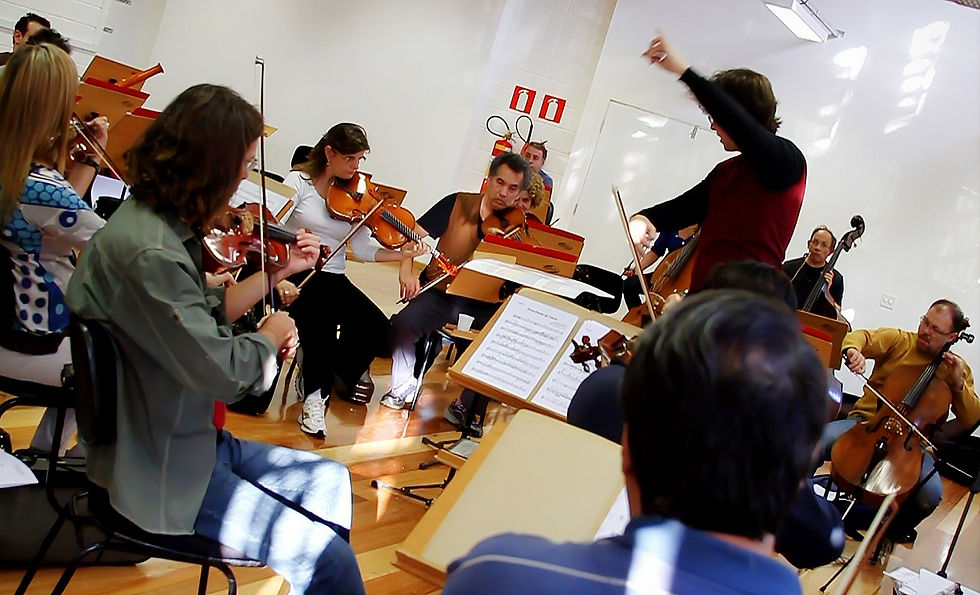

Across these projects, I worked as an instrumentalist, composer, arranger, conductor, and music director. Some of these roles were combined within the same project, while others were carried out separately in different projects or at different times. This range of activities would continue in later professional work, including Orquestra Urbana, Forró sem Palavras, the Chamber Project, and my collaborations with the Campinas Municipal Symphony Orchestra.
While developing these experiences in practice, I also began to investigate them academically. In an undergraduate research project supervised by Professor Rafael dos Santos, PhD, I analyzed the language of the Brazilian big band through arrangements written by Nailor Azevedo “Proveta” for Banda Mantiqueira.
→ Explore the technical and documentary dimension of the research: A Brazilian Approach to Big Band Writing: Inside Proveta’s Arrangements for Banda Mantiqueira
→ Explore its artistic and reflective developments: What My Research on Proveta and Banda Mantiqueira Taught Me About Musical Language

The research gave me tools to observe more precisely what I was hearing and trying to create. Analyzing scores, identifying procedures, and understanding how elements of Brazilian music were organized in big band writing helped me recognize more clearly aspects I had already perceived through listening and relate them to my own decisions in composition and arranging.
One of the works I wrote during this period, Pelos Ares, received first place in the II Ricardo Rizek Latin American Composition Competition for big band. The recognition did not bring those investigations to a close, but it indicated that the work developed within the university was beginning to resonate beyond it. Years later, the same composition would give its name to Orquestra Urbana’s first album.
Learning to Think About Music
There is another aspect of my education that I consider equally important: the university taught me how to think about music. Until then, many of my choices had been intuitive. I knew how to recognize what interested me, but I did not always have the tools to understand why particular works functioned as they did or how their decisions related to broader historical and aesthetic questions.
Courses in aesthetics, philosophy, art history, music history, and academic research expanded the way I understood creation. Analysis ceased to be only an academic exercise and began to offer tools for formulating questions, comparing solutions, and recognizing the consequences of particular artistic choices.
At the same time, I had the opportunity to study with Nelson Ayres, one of my major musical references, and work as his assistant on a project that brought symphony orchestra and jazz together within the department.
The coexistence of reflection and practice was decisive because the university offered me different musical experiences along with the resources to understand them, establish relationships among them, and make more conscious decisions.

Beyond the Curriculum
Looking back, I can see that Unicamp contributed to my education both through what I learned from individual courses, professors, and projects and through the opportunity to connect experiences that, at first, seemed to belong to different paths.
A concrete synthesis of this process appeared in 2011, in the graduation recital for my bachelor’s degree in Popular Music. I decided to bring the Unicamp Symphony Orchestra and the Coletivo Orquestral together in a symphonic jazz concert.

The concert brought together, in concrete form, elements I had been developing and connecting throughout those years: movement among different musical environments; composition and arranging for large ensembles, including the incorporation of improvisational practices; conducting; and the responsibility of creating a project capable of integrating musicians with different backgrounds.
None of this had been planned when I entered the university. Each stage emerged from a concrete need: seeking courses in another area, participating in groups, forming projects of my own, researching repertoires, writing for the musicians available, and assuming new responsibilities as opportunities arose.
Unicamp offered me a broad ecosystem in which I could explore possibilities, establish connections, and gradually build my professional path.
That experience remains present in the way I work with orchestras, big bands, chamber projects, recordings, and educational initiatives. Creating music often also means creating the conditions in which it can exist.
→ Continue exploring the next stage of my education: Between University Training and Professional Practice: My Experience at the Henry Mancini Institute
Appendix: Artistic Projects and Professional Experience During My Education at Unicamp
This appendix provides a documentary record of the principal artistic projects, research activities, teaching experiences, and professional accomplishments from the period when I studied at the University of Campinas, between 2004 and 2011. Its purpose is to complement the essayistic character of this article with a chronological record that makes its projects, roles, institutions, and outcomes easier to identify.
The experiences listed below were connected to the university in different ways. Some began in courses or institutional activities. Others were developed by students, professors, and collaborators outside the formal curriculum. Taken together, they document my work during this period as a composer, arranger, saxophonist, conductor, researcher, educator, and project creator.
Academic Education in Composition and Popular Music
PERIOD: 2004 to 2011.
EDUCATION: Bachelor’s degree in Composition, completed in 2009, and bachelor’s degree in Popular Music, completed in 2011, with training as a saxophonist.
RECORD: I entered Unicamp in 2004 to study Composition. From the beginning of my undergraduate studies, I took several Popular Music courses as electives in addition to the requirements of the Composition track. I later entered what was known as the combined track, which allowed students to complete two tracks within the Music degree, in my case Composition and Popular Music. I completed the bachelor’s degree in Composition in 2009 and remained at the university until 2011, when I also completed Popular Music, with training as a saxophonist. During this period, I also took courses in Conducting and developed parallel activities in composition, performance, arranging, research, teaching, and conducting.
Inconsciente and My First Experience with a Symphonic Jazz Ensemble
YEAR: 2004.
ROLE: Composer.
PROJECT: Inconsciente, my first work written for a symphonic jazz ensemble.
ACCOMPLISHMENT: World premiere by the Campinas Municipal Symphony Orchestra and Big Band Canavial. Inspired by rhythms from northeastern Brazil, especially baião, the work marked the beginning of my explorations between Brazilian music and writing for big band and symphony orchestra, with improvisation incorporated as a musical resource.
Brazilian Instrumental Music Quartet
YEAR: 2004.
ROLE: Saxophonist and one of the group’s creators.
INSTRUMENTATION: Saxophone, piano, bass, and drums.
RECORD: The quartet was formed with other first-year students. During a university strike, we maintained an almost daily rehearsal routine in the Institute of Arts practice rooms. The activity caught the attention of bassist Danilo Penteado, a member of Quatro a Zero, and later contributed to my joining Gafieira Camisa Amarela.
Instrumental Octet and Performance at FEIA
YEAR: 2005.
ROLE: Saxophonist, composer, and arranger.
ORIGIN: Group practice class.
MUSICAL EXPLORATION: This was one of my first projects in which I explored a more experimental and avant-garde current in my musical writing, in dialogue with aspects of Hermeto Pascoal’s aesthetic and through the use of atonality, compound meters, polyrhythm, and other procedures rarely found in more conventional repertoires.
ACCOMPLISHMENT: Preparation of repertoire for an expanded instrumental ensemble and performance at the Student Festival of the Institute of Arts (FEIA). The project took an activity that began in a course into a public presentation organized within the university’s artistic environment.
Caruwa
PERIOD: 2005 to 2009.
ROLE: Saxophonist, composer, and one of those responsible for the artistic concept.
INSTRUMENTATION: Saxophone, cello, acoustic bass, guitar, percussion, and viola caipira.
ARTISTIC CONCEPT: An instrumental group dedicated to bringing together composition and elements of Brazilian and chamber music, with improvisation incorporated into the group’s musical language and performance practice.
MAIN ACCOMPLISHMENTS: The project was selected by the Campinas Cultural Investment Fund (FICC) to record the album Caruwa, released in 2008. The album featured Léa Freire, Tibô Delor, Lívia Nestrovski, and the Oficina de Cordas de Campinas. The group was also selected by ProAC for a tour of performances and workshops in cities across the state of São Paulo and participated in my graduation recital in Composition in 2009.
Gafieira Camisa Amarela
PERIOD: During a significant part of my undergraduate years, from 2006 to 2010.
ROLE: Saxophonist and arranger.
RECORD: I joined the group at the invitation of Danilo Penteado and Lucas da Rosa, following the connection that began during rehearsals with my first quartet. The experience involved repertoires connected to samba de gafieira and Brazilian dance music, along with arranging and professional work in a larger band.
International Association of Schools of Jazz (IASJ) Meeting
YEAR: 2006.
ROLE: Student representative of Unicamp.
EVENT: 16th Annual Meeting of the International Association of Schools of Jazz, held at the University of Louisville in Louisville, Kentucky.
RECORD: Founded and artistically directed by saxophonist and educator Dave Liebman, the IASJ brought together schools and universities from different countries. The meeting included rehearsals, performances, jam sessions, classes, and exchange activities among students and professors involved in jazz education.
Unicamp’s Coletivo Orquestral
PERIOD: Approximately 2006 to 2011.
DIRECTION: Professor Mário Campos.
ROLE: Initially a saxophonist and, in later years, also a composer and conductor in special projects and performances.
RECORD: A project connected to the university environment but not limited to regular courses. Its activities included rehearsals, concerts, original repertoire, projects with guest artists, and recording. The Coletivo offered some of my first opportunities to write for a large ensemble and conduct my own compositions.
RECORDING: Participation in the album Compacto, credited to Mário Campos and Coletivo Orquestral and released by the Kalamata label.
OTHER ACCOMPLISHMENTS: Participation in my graduation recital in Composition in 2009 and in the concert concluding my bachelor’s degree in Popular Music in 2011, alongside the Unicamp Symphony Orchestra.
Interdisciplinary Project with Arrigo Barnabé
YEAR: 2008.
ROLE: Saxophonist with the Coletivo Orquestral.
CONTEXT: Unicamp Artist-in-Residence Program.
ACCOMPLISHMENT: Participation in a creative process that brought together students from Music, Dance, Performing Arts, Multimedia, and Visual Arts and resulted in presentations at the Centro de Convivência Cultural de Campinas. The project integrated music, theatrical elements, movement, and visual components in a multimedia production.
Rafael de Lima Quartet and Transfigurações Brasileiras
PERIOD: Project created around 2008, with subsequent developments through 2012.
ROLE: Saxophonist, composer, and project leader.
INSTRUMENTATION: Saxophone, piano, bass, and drums.
ARTISTIC CONCEPT: Original repertoire connected to Brazilian music, contemporary jazz, and experimental languages, with improvisational practices integrated into the development and performance of the repertoire.
MAIN ACCOMPLISHMENTS: Winner of the São Paulo stage of Furnas Geração Musical III and participant in the national final, held at the Rio de Janeiro Botanical Garden in 2009. The quartet also developed the project Transfigurações Brasileiras, selected by ProAC for a tour through the interior of the state of São Paulo between 2010 and 2011. These presentations included Transfigurações Brasileiras: Uma Perspectiva Musical at the Conservatório de Tatuí’s Painel Instrumental in 2011. The group also received funding from FICC to record an album. Released in 2012, the album documented repertoire created during my undergraduate years.
Pelos Ares (Award-Winning Composition)
YEAR OF THE AWARD: 2009.
ROLE: Composer.
MAIN ACCOMPLISHMENTS: First place in the II Ricardo Rizek Latin American Composition Competition for big band. Years later, Pelos Ares gave its name to Orquestra Urbana’s first album, recorded in 2015 and released in 2016.
RELATED LINK: Pelos Ares: Inside Orquestra Urbana’s First Album.
Graduation Recital in Composition
DATE: November 16, 2009.
LOCATION: Auditorium of the Unicamp Institute of Arts.
ROLE: Composer, saxophonist, conductor, and artistic coordinator of the program.
PARTICIPATING PROJECTS: Caruwa, Rafael de Lima Quartet, and Unicamp’s Coletivo Orquestral.
RECORD: The concert brought together, on the same evening, three ensembles representing different areas of my work during the bachelor’s degree: chamber-oriented popular music, contemporary jazz in a small-group format, and orchestral writing.
Undergraduate Research on the Language of the Brazilian Big Band
PERIOD: June 2010 to May 2011.
RESEARCH PROJECT: The Brazilian Big Band: Samba Compositions and Arrangements by Nailor Azevedo “Proveta” for Banda Mantiqueira.
INSTITUTIONS: Unicamp Institute of Arts and FAPESP, grant 2009/15878-6.
SUPERVISOR: Professor Antônio Rafael Carvalho dos Santos, PhD.
ROLE: Researcher, transcriber, and analyst.
SUBJECTS OF STUDY: Vovô Manuel; the suite based on O Samba da Minha Terra and Saudade da Bahia, by Dorival Caymmi; and the arrangement of Prêt-à-Porter de Tafetá, by João Bosco and Aldir Blanc. The research involved reconstructing full scores from the manuscripts used by the musicians, comparing scores and recordings, and interviewing Nailor Azevedo “Proveta”.
ARTISTIC DEVELOPMENT: Reorchestration of part of the analyzed repertoire for a symphonic jazz ensemble, presented in the concert concluding my bachelor’s degree in Popular Music in 2011. More than a decade later, this repertoire received a new reorchestration, this time for full big band, and became part of Orquestra Urbana concert programs.
RELATED LINK: A Brazilian Approach to Big Band Writing: Inside Proveta’s Arrangements for Banda Mantiqueira.
Experience as an Educator and Teaching Assistant
PERIOD: During my undergraduate studies.
ROLE: Secondary-instrument instructor, teaching saxophone to students studying it as a second instrument. Teaching assistant responsible for a group practice class for first-year students, including rehearsal guidance, repertoire organization, and direction of the group’s work.
Nelson Ayres Artist Residency and Work as Assistant Conductor
PERIOD: 2011.
CONTEXT: Nelson Ayres participated in the activities of the Music Department as a guest artist in residence, following an institutional model similar to the earlier residency of Arrigo Barnabé. He was not a permanent member of the Unicamp faculty.
ROLE: Participating student and assistant conductor to Nelson Ayres.
RECORD: During the artist residency, I participated in activities led by Nelson Ayres and worked as his assistant conductor on a project that brought students together in a symphonic jazz ensemble. The experience involved following rehearsals and decisions related to arranging, conducting, instrumental balance, and the integration of musicians from different backgrounds.
Concert Concluding the Bachelor’s Degree in Popular Music
YEAR: 2011.
FORMATION: The Unicamp Symphony Orchestra and the Coletivo Orquestral brought together as a symphonic jazz ensemble.
ROLE: Composer, arranger, conductor, and music director.
PROGRAM: Original works and developments from my undergraduate research, including reorchestrations of arrangements by Nailor Azevedo “Proveta” based on O Samba da Minha Terra and Saudade da Bahia, by Dorival Caymmi, and Prêt-à-Porter de Tafetá, by João Bosco and Aldir Blanc.
RECORD: The concert concluded my undergraduate path by bringing together composition, arranging, performance, research, and conducting, along with the experiences I had accumulated since 2004 in Brazilian music, jazz, big band, and symphony orchestra.
About the Author
Rafael Piccolotto de Lima is a composer, arranger, music director, and educator. A Latin Grammy-nominated composer and recipient of multiple international awards, including 13 DownBeat Awards and honors from ASCAP, he develops artistic projects that connect Brazilian music, jazz, orchestral writing, improvisation, recording production, research, education, and interdisciplinary collaboration.


Comments