
A Brazilian Approach to Big Band Writing: Inside Proveta’s Arrangements for Banda Mantiqueira

Updated: Jul 25
How do Brazilian musical references and performance practices take shape in big band writing?
That question guided part of the undergraduate research project I conducted at the Institute of Arts of the University of Campinas (Unicamp) between June 2010 and May 2011. Titled The Brazilian Big Band: Samba Compositions and Arrangements by Nailor Azevedo (Proveta) for Banda Mantiqueira, the project was supported by FAPESP (grant 2009/15878-6) and supervised by Professor Antônio Rafael Carvalho dos Santos, PhD.
The objective was not to reconstruct the history of big bands in Brazil, provide a comprehensive overview of composers, arrangers, and ensembles, or propose a universal definition of the Brazilian big band. The Brazilian tradition of writing for big bands and other instrumental ensembles is broad and diverse. It includes dance orchestras, radio regional ensembles, gafieira dance bands, frevo bands, and the work of composers and arrangers such as Moacir Santos, Nelson Ayres, Maestro Branco, and many other musicians who developed widely different approaches. I wanted to examine one contemporary manifestation of this universe in depth. Among the ensembles I knew, many had a more direct relationship with the jazz repertoire or combined different musical traditions in their work. Banda Mantiqueira, by contrast, had developed a project particularly focused on repertoire, references, and performance practices connected to Brazilian music, becoming one of the country's most significant examples of this kind of work.
That is why I chose Nailor Azevedo, known as Proveta, and his writing for Banda Mantiqueira as the subject of my research. In addition to the band's artistic importance, its activities in São Paulo, relatively close to Campinas, made it possible to seek direct contact with Proveta and conduct a study connected to the musical environment in the state of São Paulo, of which I was also a part.
Within this scope, I focused my analysis on three works composed or arranged by Proveta for Banda Mantiqueira: Vovô Manuel, composed and arranged by Proveta himself; a suite based on Dorival Caymmi's O Samba da Minha Terra and Saudade da Bahia; and Prêt-à-Porter de Tafetá, by João Bosco and Aldir Blanc. Proveta arranged the latter two. The selection therefore brought together one original composition and two works by other composers, making it possible to observe Proveta's writing in different musical situations.
Drawing on the manuscripts used by the musicians, my reconstruction of the full scores, comparisons with the recordings, and an interview with Proveta, I sought to understand and describe the compositional and arranging procedures found in this repertoire. More than identifying isolated technical devices, I wanted to understand how those procedures contributed to such a distinctive sound and to the development of a Brazilian instrumental language for large ensembles.
At the time, I was already writing for large ensembles and was actively involved in the Coletivo Orquestral da Unicamp, directed by Professor Mário Campos, who taught the university's Ensemble Performance and Arranging courses. I also worked as a saxophonist and arranger with Gafieira Camisa Amarela, an ensemble formed by Unicamp students who were conducting sustained musical research into the languages of samba and choro. The ensemble was built around the group Quatro a Zero, which had received an award in a national Brazilian instrumental music competition. At the same time, I followed Banda Mantiqueira with great interest, fascinated by how it used an instrumentation inspired by jazz orchestras to perform Brazilian music.


Why Study Proveta?
For any student interested in arranging and large ensembles in Brazil, Proveta was already an important reference. His work as a saxophonist, clarinetist, composer, and arranger held a prominent place in Brazilian instrumental music, while Banda Mantiqueira had established itself as one of the leading examples of adapting the big band format to Brazilian performance practices and repertoire.

The band's sound brought together clear influences from the great American jazz orchestras, as well as elements drawn from samba, choro, forró, wind bands from towns in Brazil's interior, and several traditions connected to Brazilian popular music. That combination pointed toward a question that deeply interested me:
How can an ensemble inspired by big bands develop its own musical identity without simply reproducing imported models?
Another important factor was the possibility of direct access to the source. Unlike many composers studied in academic settings, Proveta was professionally active and could participate directly in the research.
The Challenge of Finding the Material
Today, recordings, interviews, and other research materials circulate much more easily online, while digital tools have also expanded the possibilities for editing and sharing scores. This does not mean, however, that official editions of musical works are easy to find. Many independent artists and musicians connected to orally transmitted traditions do not publish or sell their scores, and these materials remain more readily available in certain circles, particularly in concert music and in bodies of work organized as formal catalogs.
At the time of the research, access was even more limited. Digital score editing and distribution were less common, and many materials could be obtained only through official publications or direct contact with the artists themselves. My first challenge, therefore, was reaching Proveta. It took several attempts before we were finally able to speak by phone. During that conversation, I explained the project, the research objectives, and my interest in analyzing his arrangements for Banda Mantiqueira. That contact led to our first meeting during one of the band's performances in São Paulo, when one of the most important discoveries of the entire research project emerged.
When I Discovered That the Full Scores Did Not Exist
I expected to find complete scores for the three arrangements selected for the research, as is common in many composition and arranging processes for large ensembles. A full score is the document that presents all of the ensemble's instruments simultaneously. It is where we would normally examine the distribution of chord tones among the different voices and instruments, a procedure often called voicing, as well as the counterpoint between sections and the overall organization of the writing.
During our first conversation, however, Proveta explained that he had written those three arrangements directly into the individual parts intended for the musicians. No complete scores were available for analysis. The surviving materials were the handwritten parts used by Banda Mantiqueira itself.
At the time, this surprised me. Most traditional arranging methods teach the construction of music through a vertical view of harmony and the simultaneous organization of the instruments within the full score.
The absence of full scores also helped me understand an aspect of Proveta's own process. In the edited interview transcript included in the report, he explained that because he did not play piano or guitar, it felt more natural for him to “think in terms of melodic lines.” At that point in his career, he had become accustomed to writing without a full score, building the music from the melodies and from the movement he imagined for each voice.
This did not mean that harmony, chord voicings, or formal planning were less important. What became visible was a way of constructing these elements through the paths taken by the individual lines, the relationships among the voices, and the functions imagined for each instrument.
Banda Mantiqueira's Manuscripts

The discovery created a practical problem: how could I analyze the arrangements if the full scores did not exist?
Soon afterward, an unexpected opportunity arose. Banda Mantiqueira was scheduled to perform in São Paulo, and I received permission to photograph the individual parts for all three arrangements.
This was a time when smartphones were not yet commonly used for this kind of documentation. I brought a digital camera and, between the soundcheck and the beginning of the concert, photographed the manuscripts used by the musicians page by page.
The experience was striking. Many of the parts showed clear signs of professional use: folds, worn edges, annotations, and pages that had been opened and closed countless times over the years.
These were not documents prepared for an archive. They were working tools, scores that had circulated among musicians, accumulated signs of use, and accompanied the band's history. Today, I consider those photographs an important part of the research's documentary legacy.

Reconstructing the Full Scores
Using those photographs, I began a stage that would become central to the project. I reconstructed the complete scores of the three works, bringing the individual parts back together in conventional full-score format. This process revealed details of the writing that would have been extremely difficult to perceive from the recordings alone and provided the basis for the musical analyses.
Months later, I brought the reconstructed scores to another meeting with Proveta. He was interested in seeing the material organized in a format that had not previously existed, and our review created an opportunity to check notes, correct orchestration details, and document articulations, slurs, and accents that had not appeared consistently in the original parts. This process led to one of the research project's most important reflections.

The Interview
My interview with Proveta lasted approximately four hours. In addition to discussing the arrangements under analysis, we spoke about his musical background, the history of Banda Mantiqueira, São Paulo's musical environment, his artistic influences, and his compositional process. One particularly interesting aspect was his account of the path that led to the formation of the band.

Proveta described a musical background shaped both by figures such as Mel Lewis, Thad Jones, Toshiko Akiyoshi, and Duke Ellington and by Brazil's Orquestra Tabajara and the orchestra led by Maestro Cipó. Before Banda Mantiqueira, he participated in different ensembles in which he experimented with approaches to writing for large formations and sought to understand the techniques associated with big bands.
In his account, Banda Mantiqueira emerged from the search for a way to work with the power, freedom, and instrumental resources of those ensembles without distancing himself from the Brazilian music that was part of his experience. The band's language gradually took shape through this meeting of influences, musicians, and different musical practices.
What the Analysis of the Three Arrangements Revealed
The analyses indicated that Proveta's arranging procedures were strongly grounded in techniques established and used in jazz. In the report's conclusion, I observed that the work's originality lay more in the combination of traditional elements of big band language with samba and choro than in innovations in orchestration, form, or harmony.
Among the techniques I observed were different ways of distributing chord tones among the voices and instruments, a procedure known as voicing. In a close-position voicing, the notes are concentrated within a smaller range. In a more widely spaced, or open, voicing, they occupy a broader range and do not have to appear in consecutive order.
In Proveta's arrangements, however, these distributions did not always follow traditional models of block writing for big band. Rather than always beginning with a complete chord and distributing it among the instruments, he often prioritized the linear path of each voice. Because Banda Mantiqueira also uses an instrumentation different from that of a conventional big band, some of these blocks had less complete or more harmonically ambiguous structures when compared with traditional models. This combination of independent voice leading and the specific possibilities of the instrumentation contributed directly to the distinctive sound of Proveta's arrangements for Banda Mantiqueira.
The arrangements also employed devices well established in the big band tradition, including backgrounds, written orchestral accompaniments for improvised passages; solis, melodic passages with a soloistic or improvisational character, generally harmonized and played by several instruments; and shout choruses, climactic sections that use blocks, attacks, and rhythmic figures to explore the band's full power. Other devices included falls, in which notes descend in pitch, and glissandos, produced by sliding between different pitches. The presence of these procedures did not, by itself, distinguish Proveta's writing. Their significance lay in the role they assumed in each work and in how they were combined with the arrangement's other elements.
A recurring practice in all three arrangements was the use of phrase endings, long notes, and pauses in the principal melody as spaces in which to introduce new contrapuntal lines. These lines interacted with the melody and expanded the variety and density of musical events. In Prêt-à-Porter de Tafetá, unisons, octaves, and block techniques appeared in similar proportions. In Vovô Manuel and the suite based on Caymmi's songs, Proveta favored unisons and, occasionally, octaves, reserving block techniques for specific sections in which they created contrast.
Revisiting these analyses for this article more than a decade after completing the research, I perceive additional nuances in the three works. My current reading incorporates the subsequent years I spent studying big band writing and working extensively with orchestral ensembles, composers, and arrangers in Brazil and abroad. That experience allows me to see more clearly what distinguishes each arrangement.
In the original report, I described Prêt-à-Porter de Tafetá as the arrangement closest to the aesthetic of American big bands and highlighted the speed with which new musical events followed one another as one of its characteristics. Revisiting that analysis, I no longer consider this speed a characteristic of big band writing in general. It results primarily from the tempo, the music's rhythmic profile, and the way the arrangement organizes the succession of events.
What continues to draw my attention is the agility with which lines, attacks, counterpoint, and changes in instrumentation accumulate progressively. This complexity creates movement and energy rather than merely increasing the amount of information. Of the three works, Prêt-à-Porter de Tafetá is also the arrangement that most intensely explores instrumental ranges, contrasts between sections, and the band's full sonic power. During the second statement of the theme, this energy culminates in a soloistic melodic passage written in counterpoint for the entire horn section.
The suite based on O Samba da Minha Terra and Saudade da Bahia moves in a different direction. Its slower tempo and gentler orchestration encourage a lyrical and melodic character closer to the world of samba-canção. Counterpoint remains present, but it does not create the same concentration of attacks and events found in Prêt-à-Porter de Tafetá. The writing follows the character of Dorival Caymmi's melodies more directly.
I also find the moments when Proveta expands the songs' original form especially creative: the partido-alto introduction, the short bridge built from maxixe figures, the interlude between the two songs, the improvisational sections, and the coda played by the full band, with block chords in the horns and breaks filled by the drums and percussion.
Vovô Manuel differs from the other two works because it is also an original composition by Proveta and because it unfolds more continuously, without being limited to the repetition of a fixed formal structure. At more than twelve minutes in length, the piece develops different materials over time. Its form includes an extended introduction at a slow tempo, followed by three groups of themes developed at a moderate tempo. Throughout this progression, Proveta works with samba, ijexá, and capoeira, uses clarinet and berimbau as solo instruments, and explores different homophonic and contrapuntal techniques.
The Question of Articulation
One of the research project's important questions emerged from comparing the manuscripts, recordings, and Proveta's accounts. The scores documented many compositional and arranging decisions, but on their own they did not contain all the information required to reproduce how Banda Mantiqueira performed that repertoire.

The note “Articulations?”, visible in the upper-left corner of the score, was one of the questions I had set aside to discuss with Proveta. My concern went beyond correcting the score. I wanted to understand how to document information that circulated within Banda Mantiqueira through listening, rehearsals, and shared experience, but that could help other musicians, researchers, and student ensembles study that language in the future.
During the interview, I asked what would happen when new musicians or members of later generations encountered those scores without articulation markings. I also raised the possibility of a student ensemble attempting to perform the repertoire without the presence of a musician familiar with that language. Proveta emphasized that notation could not replace the experience of listening to and practicing that music, but he acknowledged its pedagogical role. Speaking about the young musicians he taught, he explained that he marked every articulation so they could experience and understand musically the reason for each accent.
After that conversation, Proveta documented the articulations in all three works reconstructed during the research in detail. The goal was not to freeze the performance within the score, but to preserve information that could guide new performers and serve as a reference for future research into Banda Mantiqueira's language.
Accentuation, phrasing, interpretive nuances, and the rhythmic treatment of specific passages were also developed through rehearsals, performances, interaction among the musicians, and listening. Some of this information appeared in annotations added to the parts over time, but another part belonged to the band's shared musical experience.
In the edited interview transcript, Proveta summarized this relationship: “The score is only a reference. Everything I put there is an approximation of an idea, and then it has to become organic. The musician has to make this material their own when they begin to play.”
The conclusion, therefore, did not diminish the importance of the writing. It showed that the band's language resulted from the meeting of what the arrangement organized and what the musicians realized through it.
An Instrumentation Designed for This Music

Although it is often described as a big band, Banda Mantiqueira's instrumentation does not correspond exactly to the traditional jazz orchestra model. Instead of five saxophones, four trumpets, and four trombones, the band uses four saxophones, three trumpets, and two trombones, along with a rhythm section without piano. Guitar, bass, drums, and percussion provide a foundation directly connected to Brazilian musical practices.
In the interview, Proveta explained that his original idea was to combine a choro regional ensemble with brass instruments. Because that combination did not produce the sonic weight he was seeking, the musicians opted for guitar, drums, and bass, initially without percussion. Proveta also considered the distribution of the horns functional: the three trumpets could form a triad, the two trombones could complete the chord with the tritone, and the saxophones remained free to reinforce the chords or develop contrapuntal lines.
Revisiting these arrangements today, I also recognize how directly the reduced instrumentation affected the orchestration. Many traditional big band writing techniques assume complete sections. Four trumpets or four trombones, for example, make it possible to distribute four different chord tones directly. In a five-saxophone section, it is common to construct a four-part block and double the melody an octave below, or to distribute five different notes among the instruments.
With Banda Mantiqueira's instrumentation, these solutions could not be transferred in the same way. This does not mean that Proveta avoided block techniques or chord voicings. The analyses show that these devices were present, but they appeared more selectively and were combined with unisons, octaves, independent lines, and different mixed-section configurations.
This resulted in textures that were less harmonically filled out, greater independence among the voices, and, at certain moments, more ambiguity in the distribution of chord tones. Rather than always relying on complete blocks within each section, Proveta could construct the texture through the relationships among melodic lines, counterpoint, doublings, and instrumental combinations.
In my current reading, this characteristic helps explain part of the difference between Banda Mantiqueira's sound and writing for ensembles that more closely follow the traditional big band model. In many arrangements associated with Orquestra Tabajara or the work of Maestro Branco, as well as in the American references cited by Proveta, including Duke Ellington and Thad Jones, complete sections allow for other kinds of chord voicings, voice distribution, and orchestral weight. Proveta was working with a different instrumental configuration and consequently had to find different solutions.
These solutions did not produce a single sound across all the works. Each arrangement explored different instrumental combinations, including the additional instruments played by the musicians, the use of mutes, and the replacement of trumpets with flugelhorns in certain passages. Prêt-à-Porter de Tafetá, the suite based on Caymmi's songs, and Vovô Manuel each created its own sound world, even though they shared the same core instrumentation and part of the same writing vocabulary.
At the end of this article, you can hear two recordings made during a reading session with Orquestra Urbana: my reorchestrations of Prêt-à-Porter de Tafetá and the suite based on O Samba da Minha Terra and Saudade da Bahia. Because Orquestra Urbana uses traditional big band instrumentation, I had to redistribute some of the instrumental writing and restructure certain voicings in the adaptations. The recordings offer a practical opportunity to hear some of the sonic differences created by the change in instrumentation and the new orchestration solutions it required.

Is There a Brazilian Big Band Language?
The three arrangements analyzed do not allow us to define a universal language for the Brazilian big band, nor was that the purpose of the research. They do, however, offer a concrete answer regarding one specific case: the language developed by Proveta and the musicians of Banda Mantiqueira.
The Banda Mantiqueira case showed that developing a Brazilian language for big band did not require abandoning the technical resources associated with the format. The transformation occurred when those resources took on different functions in dialogue with repertoire, rhythmic practices, approaches to phrasing, instrumental choices, and musical experiences developed in Brazil.
Part of this identity was clearly constructed through the writing. Another part was completed through articulation, phrasing, and the decisions of musicians who knew those traditions and had developed a collective practice. Banda Mantiqueira's language did not exist apart from the arrangements, but neither was it contained entirely within them.
The contribution of the research was to document how these elements interacted in three specific works. Rather than proposing an abstract definition of the Brazilian big band, the project made it possible to observe one of the ways in which writing techniques, repertoire, performance practices, and musical experiences can form a language of their own.
Hear Two Proveta Arrangements in a New Instrumentation
During the research, I reconstructed the full scores of the three arrangements from the individual parts used by Banda Mantiqueira's musicians. Two of them continued to reappear at different moments in my career: the suite based on Dorival Caymmi's O Samba da Minha Terra and Saudade da Bahia, and João Bosco and Aldir Blanc's Prêt-à-Porter de Tafetá.
For my graduation recital at Unicamp, I reorchestrated these two arrangements for a symphonic jazz ensemble. The experience raised important questions about what happens when music is transferred to a different instrumentation and performed by musicians with different experiences and musical traditions.
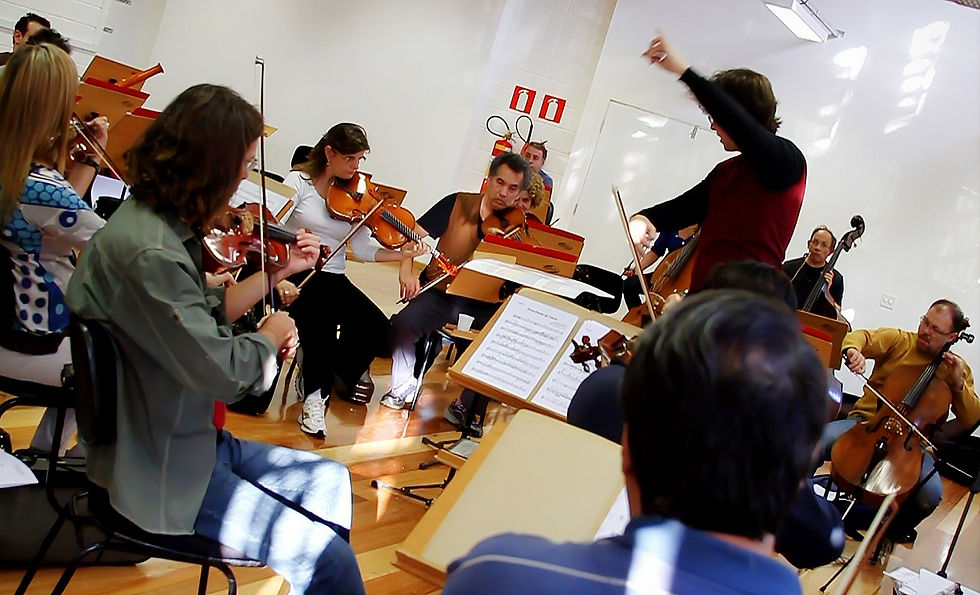
In 2024, I returned to the same material and prepared new adaptations for traditional big band instrumentation. The versions were recorded during a studio reading session with Orquestra Urbana.
By adapting these arrangements for a different instrumentation, I was able to revisit some of the research questions in practice and recognize what remained intact in Proveta's writing and what had to be reconsidered in the new instrumental context.
Final Research Report on Proveta and Banda Mantiqueira
For readers who would like to explore the research in greater depth, I am also making available the final report of the undergraduate research project The Brazilian Big Band: Samba Compositions and Arrangements by Nailor Azevedo (Proveta) for Banda Mantiqueira, conducted at the Unicamp Institute of Arts with support from FAPESP under grant 2009/15878-6.
The report includes the research context and methodology, detailed analyses of Vovô Manuel, Prêt-à-Porter de Tafetá, and the suite based on O Samba da Minha Terra and Saudade da Bahia, musical examples, considerations on articulation and interpretation, and an edited selection of the excerpts from my interview with Proveta that were considered most relevant.
The FAPESP Virtual Library maintains the official grant record and the project's bibliographic information, but it does not make the report available for download. I am therefore providing the complete PDF here, preserved in its original form as it was completed and submitted to the institution in 2011 (in Portuguese).
About the Author
Rafael Piccolotto de Lima is a composer, arranger, music director, and educator. A Latin Grammy-nominated composer and recipient of multiple international awards, including 13 DownBeat Awards and honors from ASCAP, he develops artistic projects that connect Brazilian music, jazz, orchestral writing, improvisation, recording production, research, education, and interdisciplinary collaboration.


Comments