
When Creating Music Also Means Building a Project

The Story of the Chamber Project and the Creation of a Space for an Artistic Language
During my doctoral studies, I recorded a conversation with Greek-New Zealand composer John Psathas. Among the subjects we discussed, one question kept returning to my mind in the years that followed. It was not about harmony, counterpoint, orchestration, or any other technical aspect of composition, but about what happens to a work after it is finished.

At the time, that question caught my attention because it came from someone whose career included collaborations with musicians such as Michael Brecker and Joshua Redman, as well as performances by major international orchestras.
One of his works that had impressed me most was Omnifenix, a concerto for saxophone, drums, and symphony orchestra written for Michael Brecker, who gave its premiere. The work was later recorded with Joshua Redman. Another was View From Olympus, a double concerto for piano, percussion, and orchestra connected to Greek mythology and musical traditions, which I listened to countless times during my formative years.
I imagined that someone with a career of that stature would face challenges very different from my own, but the conversation took another direction.
Psathas spoke about how certain works could be recorded, premiered by outstanding musicians, and given important performances without necessarily finding a lasting environment in which to continue existing.
We also discussed the performance challenges involved in highly specific musical languages. The musicians available are not always familiar with a particular aesthetic vocabulary. Existing ensembles are not always interested in developing that repertoire over time. Established institutions do not always have room to incorporate proposals that fall significantly outside their customary artistic identity.
The quality of the work remains fundamental, but quality alone does not ensure that it will be performed or find continuity. When I spoke with Psathas, creating the conditions needed to realize my music was not new to me. I had already formed ensembles and organized projects during my years at Unicamp. At the University of Miami and the Henry Mancini Institute, I continued to create rehearsals, recordings, and other situations in which works could take shape. All of this happened naturally, as part of the work required to realize the ideas I wanted to develop.
Even so, as a composer interested in writing for large orchestras, I still imagined that the clearest sign of success would be seeing my works enter the established repertoire or generate enough demand to circulate among orchestras in different countries.
The conversation did not introduce me to a practice I had never encountered, but it changed how I understood something I was already doing. Forming ensembles, developing projects, and creating spaces where music could be realized could have artistic value in their own right, alongside my work with existing orchestras and established institutions. This path did not replace institutional collaborations, but it opened different possibilities for experimentation, continuity, and the development of an artistic language.
Years later, the Chamber Project would become a concrete realization of that possibility. Instead of waiting for an existing ensemble to embrace that language, I could create a project designed to develop it. This article follows that trajectory, from the questions raised in my conversation with Psathas to the first recording and the project's subsequent development.
→ READ ALSO: Between Classical Composition, Jazz, and Brazilian Music: My Musical Education at Unicamp
→ READ ALSO: Between University Training and Professional Practice: My Experience at the Henry Mancini Institute
The Music I Wanted to Make
This reflection found fertile ground in an artistic concern that had been with me for a long time. From an early age, I was fascinated by different musical worlds: the timbral richness of symphony orchestras, the creative freedom of improvisation, the tradition of Brazilian instrumental music, and writing for big bands and jazz orchestras.
Throughout my education and professional career, I had opportunities to develop work with symphonic jazz ensembles that move among these territories. In 2014, I took part in the Metropole Orkest Arrangers Workshop in the Netherlands, writing for a concert featuring Gregory Porter under the direction of Vince Mendoza. In 2016, the Symphonic Jazz Orchestra gave the world premiere of Trickster in Los Angeles, a movement from Seven Masks created as part of my doctoral research.
That path continued through my ongoing collaboration with the Brasil Jazz Sinfônica, for which I have written arrangements every year since activities resumed after the pandemic. Among these projects was a 2023 concert at Sala São Paulo devoted to the world of forró, featuring Chico César, Mestrinho, and Mariana Aydar. I wrote three arrangements for the performance, which was broadcast by TV Cultura.
In very different contexts, these projects showed how contemporary writing for large ensembles could bring Brazilian music, jazz, and concert music into dialogue, incorporating improvisational practices without erasing the identity of each language.


Most of these projects, however, share one characteristic: they depend on complex institutional structures involving dozens of musicians, production teams, ongoing funding, rehearsal spaces, and all the infrastructure that makes their existence possible. That structure also shapes how each collaboration can unfold.
For a guest composer or arranger, these collaborations represent extraordinary opportunities. At the same time, they depend on invitations and on the artistic direction of the institutions involved. The format of the project, its goals, and its possibilities for continuity are negotiated with the people responsible for artistic and institutional decisions. Even when the work allows creative freedom, the composer does not necessarily have the autonomy to create the project, determine its entire direction, or decide what will happen next.
This does not diminish the value of these experiences, but it does reveal a defining characteristic of institutional collaborations. The question I was asking myself was different: what happens when an artistic vision cannot find a space in which to develop with autonomy and continuity?
Over the course of a career, it is possible to accumulate important performances, commissions, and collaborations without necessarily building an environment in which a composer can determine a project's artistic direction and develop it over time. I was looking for precisely that combination of autonomy and continuity. At this point, my conversation with John Psathas began to take on even greater meaning for me.
The Work and Its Environment
Institutions develop identities of their own over time. They cultivate audiences, build repertoires, and establish expectations about the kind of artistic experience they offer. Musicians likewise develop specializations, performance habits, and particular ways of interpreting music. A highly specific artistic vision does not always find the ideal environment in which to grow within these structures. This is not a criticism, but simply a characteristic of this world.
Maria Schneider has always been an important example for me because her career brings artistic autonomy and institutional collaboration together with particular clarity. Leading her own big band, she built an independent environment in which to develop repertoire, a musical language, and projects that have received multiple Grammy Awards and other honors. At the same time, she has maintained an international career as a guest composer and arranger on projects with other ensembles and institutions.
It is precisely the balance between these two paths that makes her career so relevant to this reflection. Her own band provides continuity and autonomy for the development of an artistic vision, while external collaborations allow that language to reach other ensembles and contexts.

The continuity of the Maria Schneider Orchestra allows its musicians to live with the repertoire for years, become deeply familiar with its language, and help the works mature in ways that would be difficult to achieve through isolated performances. The work and the environment that makes it possible evolve together. In this case, autonomy does not mean isolation, but the existence of an artistic foundation from which other collaborations can also emerge.
Moving to New York
When I moved to New York in late 2016, I was completing my doctorate at the University of Miami. Until then, my artistic life had been connected to an institution that facilitated the realization of projects through the ensembles, musicians, and infrastructure provided by the Frost School of Music and the Henry Mancini Institute. The move marked the first period of my adult professional life in which I no longer had that kind of recurring institutional connection.

In New York, I began working as an independent artist in a city where I was still building my professional relationships. The BMI Jazz Composers Workshop became one of my first points of contact with the local community of composers and arrangers. The program offered reading sessions in which I could hear and revise new works, but the time devoted to each participant was limited. In general, I had about fifteen or twenty minutes of reading time every two months. At the end of each cycle, selected works were featured in the annual concert associated with the Charlie Parker Jazz Composition Prize, for which I was a finalist on two occasions.

BMI therefore served an important purpose, but a different one from an institution that commissioned works or provided the conditions for the extensive development of an original project. In this new context, the question of autonomy and continuity took on a practical dimension: how could I develop a project capable of exploring that musical world without depending on a large institution's artistic direction or permanent infrastructure? I still did not have a detailed plan, but I was beginning to understand that I would need to take the initiative and build that space myself.
→ READ ALSO: The BMI Jazz Composers Workshop and the Challenges of Developing Original Music for Big Band
A few months after the move, I began discussing this idea with audio engineer Vitor Hirtsch. At the time, he was completing his graduate studies at New York University and had access to the university's studios through his program. In one of those conversations, a simple possibility emerged: using that space to begin the project.
At that point, the Chamber Project did not yet exist. There was no performance history, no rehearsals, and not even an established instrumentation. There was only an artistic intention.
From there, I began attending performances, meeting musicians, and closely observing the city's music scene. I was looking for people who could move naturally among different musical languages: musicians comfortable both reading notation and improvising, coming from jazz, Brazilian music, and concert music, and curious about this hybrid territory.
Each invitation was made individually. I was not simply choosing musicians. I was trying to build an environment.

The Chamber Project's First Recording
The recording was scheduled for March 2017. One of the works from that session was called Caipora, and I finished composing it the night before the recording. I remember completing the final details of the score in the early hours of the morning, only a few hours before entering the studio.
The following morning, more than twenty musicians passed through the James L. Dolan Studio at New York University at different times throughout the day. The parts had just come off the printer, and there was no rehearsal. Because it would have been difficult to gather all of those musicians for a longer period, I planned the recording in successive blocks: horns, strings, and rhythm section were recorded separately over the course of the same day.
During my master's and doctoral studies at the Frost School of Music, my experience in the university's studios had taught me how to organize sessions of this kind. I already understood which elements could be recorded separately and later overdubbed, as well as how to structure the work to preserve efficiency and flexibility within the available time.
The music needed to exist as a complete conception before all of its parts could be heard together. Using a click track prepared in advance, I conducted each session from the musical image I had of the work, seeking to communicate precisely what the musicians needed to accomplish at each stage. The organization resembled many film-scoring sessions, in which different sections of an orchestra may be recorded separately and later assembled.

This was not yet the kind of process in which a work matures through rehearsals, successive performances, and relationships built with musicians over time. The circumstances did not allow for that kind of development. The goal of the session was to get the Chamber Project off the ground within the conditions available and establish an initial foundation for future work.

As the different parts were recorded, I began to hear that musical world take on a tangible form. There was the adrenaline that naturally accompanies a recording, but also the realization that experiences accumulated during my years at the university, in institutional projects, and through different collaborations were converging into something built from an artistic vision of my own. This was not yet the maturation of that language, but the beginning of the environment in which it could continue to develop.
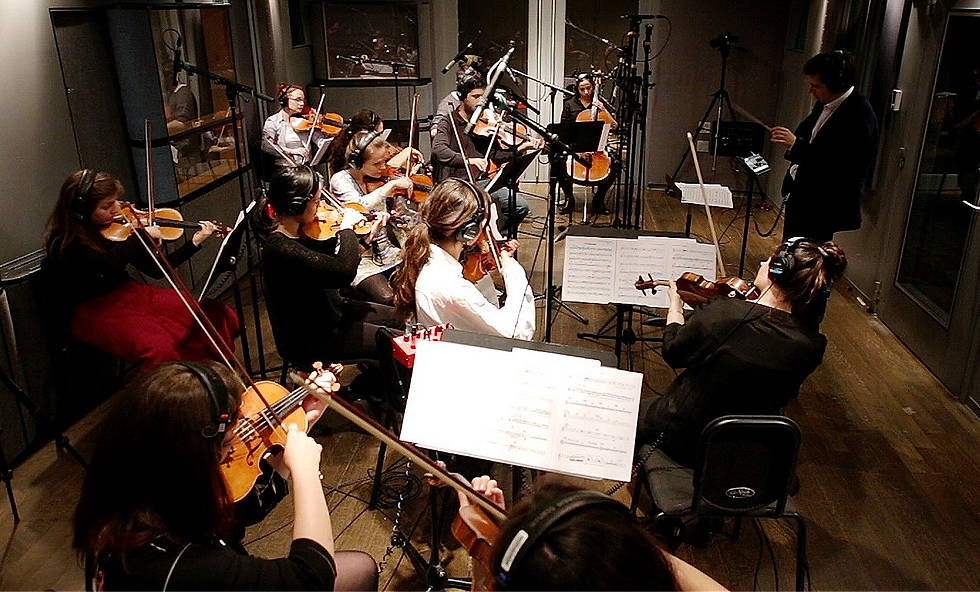
What happened in that session was more than a recording. It was a concrete attempt to build a space in which that musical world could exist. The Chamber Project emerged from that encounter, not as a fixed group or rigid instrumentation, but as an artistic platform capable of taking different forms according to the needs of each project.
The Chamber Project's Early Development
After the initial recording, the Chamber Project's next step was to bring that repertoire before an audience and begin building a performance history. The continuity of these experiences would allow the works, the project's internal dynamics, and the interaction among the musicians to mature naturally.
Soon afterward, we gave our first performances at Rockwood Music Hall. The venue was charming and intimate, but the stage could not accommodate the entire ensemble. Some musicians had to sit offstage, and I conducted from the floor in front of the stage, as the photograph below shows. The audience and scale of those performances were modest compared with the projects that would follow. Even so, the concerts marked an important change: the repertoire was leaving the studio, reaching an audience, and becoming part of the city's musical life.

Later, Forró Sem Palavras emerged within the Chamber Project, initially as a repertoire and concert concept belonging to the project itself. Its music continued the integration, already present in the Chamber Project, of Brazilian music, chamber writing, and improvisational practices. Over time, the work gained momentum, began taking on different instrumental configurations, and became an independent project.
→ CONTINUE EXPLORING: Forró Sem Palavras: Building Bridges Between Forró, Jazz, Concert Music, and the Contexts Where Music Lives

One of the major milestones in this trajectory came in 2019, when one configuration of the Chamber Project, presented as the Chamber Orchestra, performed for a week with Romero Lubambo at Dizzy's Club at Jazz at Lincoln Center. The concerts were recorded live and became the album Live at Dizzy's, later released by Sunnyside Records.
→ CONTINUE READING: My Collaboration with Romero Lubambo at Jazz at Lincoln Center: Arrangements, Music Direction, and a Live Album


Autonomy and Continuity for an Original Body of Work
The Chamber Project became one of the central spaces for developing my original work in New York. Through it, I was able to create repertoire with greater artistic autonomy, build a history of performances and recordings, and develop ongoing relationships with musicians interested in that musical world. Its importance lies not only in the support it offers the works, but in the artistic identity built around them.
Independent projects and institutional collaborations are not stages in a hierarchy or mutually exclusive paths. Institutions can offer scale, structure, and access to other audiences. An independent project, in turn, can provide autonomy and continuity while making an artistic language more visible and attracting the interest of orchestras, curators, and other institutions. In many cases, work developed independently is precisely what opens new institutional possibilities.
The central question, then, is not only what happens to a work after it is finished, but how to keep an original body of work alive over time. Composing music and building projects remain different activities, but they can carry equal artistic importance. The trajectory of the Chamber Project shows that creating an environment for a musical language is not necessarily secondary to the act of creation itself: it can be one of the principal ways in which that creative work develops, reaches an audience, and continues to exist.
About the Author
Rafael Piccolotto de Lima is a composer, arranger, music director, and educator. A Latin Grammy-nominated composer and recipient of multiple international awards, including 13 DownBeat Awards and honors from ASCAP, he develops artistic projects at the intersection of Brazilian music, jazz, and orchestral writing. His work also encompasses recording production, research, education, and interdisciplinary collaboration.


Comments