
Forró Sem Palavras: Building Bridges Between Forró, Jazz, Concert Music, and the Contexts Where Music Lives

For many years, I noticed a curious reaction when people came to know different parts of my trajectory.
In environments connected to concert music and orchestral writing, people were often surprised to discover the place that forró and partner dancing occupied in my life. In the same way, at parties and within dance communities, many people were surprised to discover that I worked as a composer, arranger, and conductor.
In a certain sense, that reaction was understandable. Socially, these contexts often occupy very different spaces. The forms of listening, the environments, the goals, and even the expectations surrounding the music are usually distinct.
Within my own life, however, they had always coexisted naturally, even though they belonged to contexts that normally did not meet.
In 2018, an opportunity arose to transform that coexistence into an artistic project.
What would happen if these worlds began to engage in a deeper dialogue? Not only as occasional references to one another, but as part of the same musical inquiry?
That is how Forró Sem Palavras began.

In 2018, I received an invitation to present a concert at El Taller Latinoamericano in New York.
At that time, I had been developing the Chamber Project, a project I created in New York to explore points of contact between Brazilian music, jazz, and chamber music.
After many years writing for big bands, orchestras, and other large instrumental formations, that work became a space for investigating similar questions in smaller groups that were more flexible and compatible with the reality of independent production.
→ Related Article, reflections on the creation of the Chamber Project: Are Creating Music and Creating Projects the Same Thing?
On that occasion, while speaking with the event producer, I mentioned an unusual idea: dedicating part of the evening to a new repertoire inspired by the instrumental tradition of forró, with new compositions and arrangements, inviting the audience to participate actively through dance, transforming part of the concert into a dance party.
The proposal also created a natural bridge with the forró community I was part of and was helping to build in New York through Forró New York.
She loved the idea, and that was how a project began that would mark my musical life for the following years.

That concert was divided into two parts.
In the first, the audience occupied the chairs arranged inside the gallery to watch the instrumental presentation in a concert format.
In the second, after an intermission, the chairs were removed and the space was transformed into a dance floor.
It was there that I presented, for the first time, an instrumental forró repertoire conceived specifically for that context, seeking to create music that could simultaneously sustain the attentive listening of a concert and the collective experience of dance.
The audience’s interest, the dancers’ response, and the conversations that emerged after the concert made it clear that there was something there worth exploring more deeply.
That experimental concert ended up marking the birth of Forró Sem Palavras.
The response to the inaugural concert was so positive that, a few months later, we were invited to return to El Taller Latinoamericano for a performance entirely dedicated to Forró Sem Palavras.
Watch below one of the pieces recorded at that concert.
A Question That Existed Before the Project
Although Forró Sem Palavras emerged at that moment, the questions that gave rise to the project had accompanied me for much longer.
Throughout my education and professional trajectory, I had always been interested in spaces of encounter between different musical languages.
My doctoral research investigated relationships between jazz and concert music. As a composer, arranger, and music director, much of my work has been connected to the idea of musical traditions that preserve their identities while engaging in dialogue with one another.
→ Related Article: Blurred Distinctions: What My Doctoral Research Taught Me About Jazz, Concert Music, and Hybrid Languages
Forró Sem Palavras was born when that same curiosity turned toward a musical world that had been part of my life for many years.
I saw in forró a potential to develop in directions that rarely appeared in the more conventional forms of presenting the genre.
I also observed that many composers and groups connected to Brazilian instrumental music had already explored rhythms such as baião, xote, and other elements from the universe of forró as raw material for new musical proposals. In many of those works, however, the music gradually moved away from the context of dance and from the social experience associated with dance parties.
This was not an entirely new question for me either. Elements connected to baião, maracatu, and other musical traditions from Northeastern Brazil had often appeared in earlier works. My own debut as an orchestral composer, with the piece Inconsciente, presented by the Orquestra Sinfônica Municipal de Campinas in 2004, used rhythms associated with that universe.
The difference was that, in those contexts, those elements were part of musical proposals aimed primarily at listening. What began to interest me at that moment was a different question: would it be possible to expand the possibilities of instrumentation, arrangement, improvisation, and composition without giving up the pulse, the energy, and the relationship with dance that had always been part of the language of forró?
From that point on, the project began to exist in different formats, contexts, and formations, receiving dozens of new arrangements over the years.
From El Taller Latinoamericano, the art gallery where it had its debut, to performances in concert halls, festivals, symphonic projects, and jazz-related spaces, the project eventually became a space for exploring different possibilities within the language of instrumental forró.
Watch below a compilation with excerpts from some of these performances between 2018 and 2022.
→ Related article: How I Found My Place Between Brazilian Music, Orchestral Composition, and Jazz
Forró as a Source of New Possibilities
Long before this project existed, forró already occupied an important place in my life. For decades, I participated in dance parties, events, and communities connected to this culture. Dancing is one of the social activities I enjoy most.
At the same time, my professional work followed paths connected to composition, arranging, jazz, Brazilian instrumental music, and writing for concert music settings.
Forró Sem Palavras emerged from the meeting of those interests.
Watch below an informal conversation with Alice Rodrigues, a forró dance instructor, in which I talk about some of that journey and the motivations that led to the project.
My interest was never to deconstruct forró or use it merely as a starting point for another musical language.
What interested me was exploring how elements that had already been part of my artistic life - especially jazz and orchestral writing - could enter into dialogue with forró without making it any less recognizable as forró.
Part of the curiosity came from being able to move freely through that territory. At times, the music remained very close to traditional forró practices. At others, it incorporated elements of improvisation, arranging, and orchestral writing that brought it closer to jazz or concert music.
In many ways, it was a continuation of questions that had already appeared in my research on musical dialogues, now redirected toward a musical world that had been part of my life long before it became the subject of artistic inquiry.

Over the years, that exploration took many forms. The project never had a fixed instrumentation. Each ensemble grew out of the musical questions being explored, the musicians involved, and the context in which the music would be performed, ranging from small groups and chamber ensembles to big bands and orchestras.
The music itself also adapted to different settings, from concert halls to dance environments.
For the first time, musical questions were interacting directly with different modes of listening, forms of social participation, and experiences connected to dance.
When Music Meets Social Context
One of the things this project helped me understand more clearly is that music changes not only when its instrumentation changes, but also when the social practices and environments surrounding it change.
In concert halls, cultural venues, and performances designed for focused listening, Forró Sem Palavras found a particularly receptive environment for elements that had long been part of my language as a composer.
Silence, dynamic contrasts, changes in density, timbral exploration, formal development, and moments of great intensity followed by passages that were delicate and nearly silent.
Experiences such as the Instrumental SESC Brasil performance and the symphonic concerts developed in collaboration with the Orquestra Sinfônica Municipal de Campinas showed how naturally this music could unfold within attentive listening environments.

Dance settings, however, presented a different set of creative challenges. The way people occupied the space, listened to the music, and interacted with one another was quite different from what I encountered in concert halls and other focused listening environments.
At a dance party, music does not occupy the same place it does in a concert hall. People are there to dance, talk, meet friends, and participate in a collective experience. Music is what organizes that experience, but it is not always the exclusive center of attention.
That reality directly influenced musical decisions.
Certain musical choices that work beautifully in a concert hall produced very different results in those settings.
In some contexts, especially smaller events without extensive sound reinforcement, I noticed that the more delicate moments of the music could disappear beneath the conversations happening around them.
While a concert hall protects silence and structures social interaction around specific moments, a dance party works differently. People talk, reconnect with friends, tell stories, laugh, and move through the room while the music continues. That coexistence of music and social interaction is part of the nature of the environment itself.
In those contexts, the music needed to maintain a more constant presence. Moments of silence, sudden drops in intensity, or highly delicate passages did not always create the same effect they would have in a concert hall.
Something similar happened with pulse. Certain kinds of rhythmic flexibility that feel completely natural in concert music needed to coexist with a very practical responsibility: keeping the dance moving.
Groove became more than an aesthetic choice. It became something that physically supported the dancers’ experience.
Those conditions shifted the creative focus toward other aspects of writing and performance.
Over time, I came to understand these characteristics as part of the language of the setting itself. Just as a concert hall encourages certain musical choices, a dance environment encourages others.

An Experience I Never Forgot
On some occasions, these questions became especially clear.
I remember one performance where part of the audience wanted to listen closely to specific moments in the repertoire, while another part used the space much as they would any other social gathering.
At one point, in the middle of that tension between listening and social interaction, I picked up the microphone and proposed an unusual experiment.
I invited everyone to dance to one piece in complete silence, without side conversations.
The goal was not to turn a dance party into a concert hall. It was simply to explore, for a few minutes, a different form of attention, a deeper connection with one’s partner, with movement, and with the music itself.
Many people accepted the invitation. Others continued experiencing the event in the way that felt most natural to them. Their reactions made it clear that different people were connecting with the music for different reasons.
One of the most interesting outcomes of the project was creating spaces where different forms of participation could coexist.


It is probably no coincidence that this exploration emerged in New York.
In a city so deeply associated with jazz and major concert music institutions, forró was still a relatively new language for many musicians and listeners. That created an especially fertile environment for experimentation, collaboration, and dialogue between different musical traditions.
From New York to Montreal
Years later, a performance in Montreal would bring together many of the questions that had accompanied the project from the beginning.
As part of the opening of the Montreal Forró Festival, Forró Sem Palavras performed at Théâtre de Verdure, a large outdoor amphitheater located in one of the city’s parks.


According to the festival organizers, approximately 2,400 people attended the performance, making it the largest audience in the project’s history at that point.
The physical layout of the space brought together, almost literally, situations that had appeared repeatedly throughout the project’s history.
In front of the stage, thousands of people sat and listened to the concert.
Behind the orchestra, directly on stage, roughly one hundred festival participants danced throughout the entire performance.


The same music was being experienced in different ways at the same time. While part of the audience listened attentively to the concert, festival participants transformed the stage itself into a dance floor.
Years earlier, at El Taller Latinoamericano, the transition from concert to dance party had happened during an intermission, when the chairs were removed to make room for dancing.
In Montreal, concert and dance party occupied the same space simultaneously.

An Ongoing Exploration
Forró Sem Palavras began as an exploration of musical possibilities contained within the world of forró.
Along the way, it also became an exploration of context, listening, participation, community, and artistic creation.
That remains one of the reasons the project continues to be meaningful to me.
My interest has always been in the transformations that happen when different musical traditions come into contact, influence one another, and remain recognizable in their own identities.
Forró Sem Palavras continues to be one of the projects through which I explore those questions.
Some of the Forms This Exploration Has Taken
The reflections in this article grew out of experiences accumulated throughout the project’s trajectory. While it would be impossible to summarize every path the project has taken in a single text, some performances marked particularly important moments in the expansion of the artistic questions that gave rise to Forró Sem Palavras.
The examples below are not intended to document the entire history of the project. Instead, they highlight some of the forms this exploration has taken over the years, examining different relationships between forró, jazz, concert music, listening, and social participation.
Forrobodó NY Festival (2018)
A few months after its debut at El Taller Latinoamericano, Forró Sem Palavras received its first full presentation as part of a forró festival during Forrobodó NY Festival, one of the first large-scale forró events I organized in New York.
The concert was conceived as a tribute to Luiz Gonzaga. Much of the repertoire consisted of new arrangements and reinterpretations inspired by his music, exploring possibilities that extended beyond the genre’s more traditional presentation formats.
Although the project was conceived primarily as an instrumental experience, this performance also featured special guest appearances by singer Chambinho on several pieces.
SESC Campinas and the First Performance in Brazil (2019)
Shortly afterward, in early 2019, Forró Sem Palavras returned to Brazil for the first time. The concert took place at SESC Campinas and revealed, quite clearly, some of the questions that would later become central to the project.
The performance took place in the large central hall of the venue. Close to the stage, many people listened attentively to the concert. At the same time, dancers occupied other areas of the space spontaneously. The same music was being experienced in different ways by different audiences.
Looking back, I see that performance as an early glimpse of questions that would continue to reappear in many other settings. The coexistence of focused listening, social participation, and dance was already present there.
Jazz at Lincoln Center and the Collaboration with Romero Lubambo (2019)
A few weeks later, also in early 2019, elements of the Forró Sem Palavras repertoire became part of a performance alongside guitarist Romero Lubambo at Jazz at Lincoln Center in New York.
Although it was not a concert dedicated specifically to the project, it marked an important moment in its trajectory. For the first time, music and arrangements developed within this world were presented in one of the most emblematic venues in international jazz.
The concert was recorded live and later released as an album, creating a lasting document of an important stage in the project’s artistic development and reinforcing its connection to jazz.
→ Related Article: From the Chamber Project to Jazz at Lincoln Center: Recording with Romero Lubambo and the Path of an Original Project
Dancing with a Big Band: New York Jazz Composers Mosaic at the DiMenna Center (2019)
One of the most unusual experiences in the project’s history took place in 2019 during a concert by the New York Jazz Composers Mosaic at the DiMenna Center for Classical Music in New York.

The concept of the event was to incorporate visual and cultural elements as part of the musical performance.
Sharing the program with composers Migiwa Miyajima and Jihye Lee, each of us brought references connected to the cultural traditions that influenced our music.
While Miyajima incorporated a scene involving samurai swords and Jihye Lee worked with elements of traditional Korean dance, I presented an original composition, Xote Por Vir, inspired by the world of forró and originally written during the early stages of both the Chamber Project and Forró Sem Palavras.

At one point during the performance, I stepped away from the conductor’s podium to dance with Sabrina Evangelista, who was also teaching forró in New York at the time.
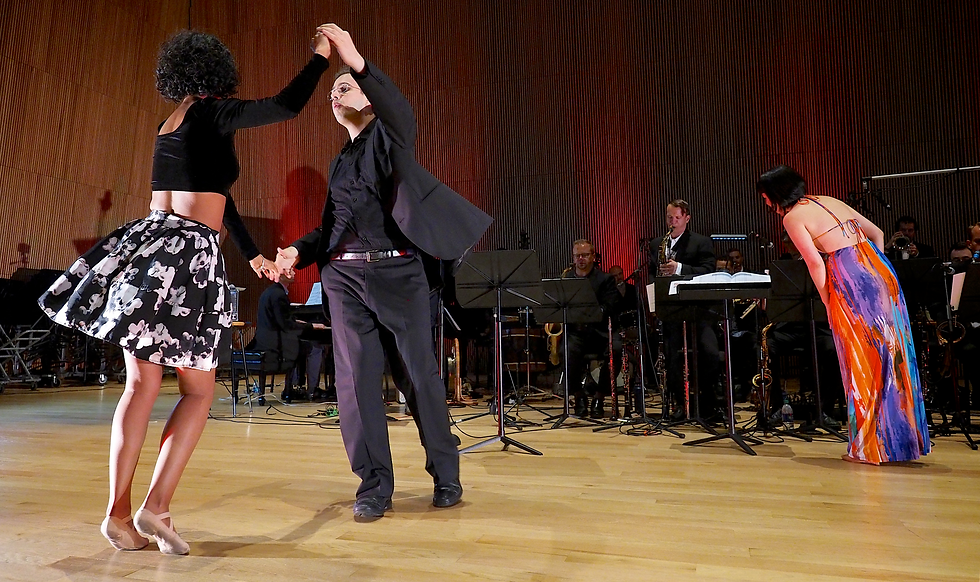
Migiwa Miyajima then took over conducting duties, allowing dance to become part of the performance itself.
It was one of the first occasions in which the project explicitly explored dance as an integrated element of the artistic presentation rather than simply a spontaneous response from the audience.
Forró Sem Palavras Symphony and the Orquestra Sinfônica Municipal de Campinas (2019)
One of the project’s most ambitious expansions took place in 2019, when Forró Sem Palavras received its first large-scale symphonic version in a concert with the Orquestra Sinfônica Municipal de Campinas.
The repertoire received new arrangements and orchestrations created specifically for that setting. Joining the orchestra were musicians I deeply admire, including Toninho Ferragutti, Paulo Braga, Edu Ribeiro, Cleber Almeida, Vinícius Barros, and Zé Alexandre Carvalho.
More than simply adding an orchestra to forró, my interest was to explore points of connection between the language of concert music and the world of instrumental forró. Rather than using the orchestra as a backdrop or a source of added volume, the goal was to create a repertoire in which both traditions actively participated in shaping the musical language.
It remains one of the most meaningful concerts I have ever produced and one of the experiences that expanded the project’s horizons the most.
Danças da Quarentena: An Online Collaboration (2020)
During the pandemic, when live performances were no longer possible, Forró Sem Palavras took on a completely unexpected form.
Drawing on relationships built over many years, the project brought together more than seventy musicians from different countries in a large-scale remote recording collaboration. Some participants had worked with me in previous projects. Others became involved through relationships that had emerged around the community connected to Forró Sem Palavras.
The result was Danças da Quarentena, a project created at a time when in-person encounters were temporarily impossible, yet the need to create, collaborate, and remain connected felt as strong as ever.
Watch also the video created through the participation of dozens of amateur and professional dancers who collaborated with the project during that period.
The project also featured the participation of visual artist Vicente Magalhães, who created an artwork inspired by the music. Watch below a video documenting that creative process.
Forró, Song, and Orchestra: Brasil Jazz Sinfônica at Sala São Paulo (2023)
Although it was not a Forró Sem Palavras performance, some of the questions explored through the project also began to appear in other work I developed as an arranger.
In 2023, I participated in the Encontros Históricos series presented by Brasil Jazz Sinfônica at Sala São Paulo and broadcast by TV Cultura, creating arrangements for a concert dedicated to forró and Northeastern Brazilian music featuring Chico César, Mariana Aydar, and Mestrinho.
Unlike Forró Sem Palavras, the focus of that project was song. Even so, it offered an opportunity to explore similar questions in a different artistic setting: the dialogue between song, the language of forró, orchestral writing, and the possibilities offered by a large jazz-symphonic ensemble.
It was another occasion in which elements traditionally associated with dance halls and popular celebrations found their way into a setting associated with focused listening and the concert hall tradition.
National Sawdust and the Coexistence of Concert and Dance Party (2023)
Over the years, one of the recurring questions of the project was finding spaces capable of accommodating both the focused listening of a concert and the physical participation associated with dance.
One of the most successful examples came in 2023, when Forró Sem Palavras was presented as part of Forró New York Weekend at National Sawdust in Brooklyn.
The venue, dedicated to contemporary music and experimental artistic creation, has an unusual configuration. While offering the acoustic and technical conditions associated with a high-level concert hall, it also allows audiences to move freely and occupy the space in more flexible ways.
This created a rare situation: a concert that could be experienced attentively by those who wanted to focus on every musical detail while simultaneously being experienced physically by those who chose to participate through dance.
Few venues have embodied so clearly the questions that Forró Sem Palavras has explored since its beginning.
Instrumental SESC Brasil and Focused Listening (2024)
In 2024, Forró Sem Palavras was invited to perform as part of Instrumental SESC Brasil, one of the most important concert series dedicated to Brazilian instrumental music.
The ensemble brought together musicians with whom I had already been collaborating in different contexts, including members of Orquestra Urbana and a string quartet formed by musicians connected to some of São Paulo’s leading musical institutions.
Unlike many performances presented in dance-oriented environments, this concert took place in a setting devoted to focused listening. The audience was there specifically to hear the music.
That context made it possible to explore aspects of the writing that often benefit from a quieter and more attentive environment, including dynamic contrasts, broader formal development, timbral exploration, and passages of great delicacy.
It was one of the experiences that most clearly demonstrated how the same musical language can reveal different characteristics depending on the setting in which it is presented.
Explore More About Forró Sem Palavras
The videos above represent only a small part of the project’s story. Additional recordings, including symphonic performances, live concerts, and a variety of ensemble formats, can be found through the links below.
About the Author
Rafael Piccolotto de Lima is a composer, arranger, music director, and educator. A Latin Grammy-nominated composer and recipient of 13 DownBeat Awards, he teaches, mentors, and supports musicians in the areas of composition, arranging, musical creativity, and artistic development.


Comments