
How Is a New Orchestral Work Created? From Commission to Premiere

A new orchestral work does not necessarily begin with the score, nor does it end when the writing is complete. Between an initial idea and its premiere lies a process that involves both musical creation and the practical conditions needed to bring it to life.
That path may begin with a commission, an initiative from the composer, or a conversation with a soloist or conductor. Along the way, the creative process intersects with practical decisions, professional relationships, and the work of the performers who will bring the music to the stage.
This article looks at that process on a broad scale. Rather than examining the technical details of writing melodies, harmonies, or musical forms, it focuses on the path through which a musical possibility becomes an orchestral work and reaches its first performance.

There is no single path. To explore some of these possibilities, I draw on concrete experiences from my own trajectory as a composer of orchestral works. They are not intended to establish a universal model, but to show how different ideas, opportunities, and collaborations can contribute to the creation and realization of a work.
What Is a Musical Commission?
A musical commission, in the strict sense, occurs when a soloist, orchestra, festival, or institution asks a composer to create or develop a new work for a particular context. The agreement may establish the instrumentation, duration, deadline, premiere setting, and financial terms. The details vary, but there is a recognizable request connecting the composer’s work to a specific project and an intended realization.
Not every opportunity that leads to the creation or premiere of a work constitutes a formal commission. Festivals may select works that have already been written, composition competitions may reward existing pieces, and academic initiatives may provide performers and a concert without directly commissioning the music. Collaborations and proposals initiated by composers can also create opportunities for new works through arrangements that differ from a traditional commission.
These distinctions are important, although all of these paths belong to the broader process discussed here: the meeting between a creative initiative and the conditions needed to bring it to life. In the academic world, for example, institutes and university ensembles may either commission new compositions or create concerts in which they can be premiered. During my time at the Henry Mancini Institute, I wrote Asas, Zóio e Matulão, a work commissioned by the institute and presented in one of its concerts. The Brazilian Contemporary Music Biennial, organized by Funarte, represents a different model: its 2021 edition included 44 world premieres, although not all of those works necessarily originated as commissions.
Other commissions originate with soloists interested in expanding the repertoire for their instruments. That was the starting point for the Brazilian Concerto for Tuba and Orchestra, which I discuss in the next section. In this case, tubist Patricio Cosentino's invitation connected the work from the outset to a performer, an artistic purpose, and a concrete prospect of a premiere.
Professional relationships built over many years can also give rise to new works. Rasga Villa, for example, grew out of a commission from the Brasil Jazz Sinfônica after a collaboration that already involved concerts, arrangements, and musicians we knew in common. In other situations, the initiative comes from the composer. Forró Sem Palavras Sinfônico began with a proposal I presented to the Campinas Municipal Symphony Orchestra and resulted in a concert featuring world premieres, Brazilian premieres, and new arrangements prepared specifically for that occasion.
Composition competitions offer another possibility. At the first Jazz Sinfônica Composition Biennial, held in 2015, works by Brazilian composers were selected for performance by the orchestra. My participation with Inconsciente contributed to the work's later inclusion in its programming. At the BMI Jazz Composers Workshop, where I was a finalist in two editions, the winner of the Charlie Parker Jazz Composition Prize receives a $3,000 award tied to the commission of a new work, which is premiered by the BMI/New York Jazz Orchestra at the following year's concert.
These are different mechanisms, but all of them bring a creative initiative closer to the professional conditions it needs to become a work performed for an audience.
Example: Brazilian Concerto for Tuba and Orchestra
One example of a commission initiated by a soloist is the Brazilian Concerto for Tuba and Orchestra, which I recently wrote at the invitation of tubist Patricio Cosentino. The partnership grew out of his interest in expanding the original repertoire for tuba and was connected from the beginning to a concrete prospect of realization with a symphony orchestra.
Patricio is developing a project devoted to new works for solo tuba by Latin American composers. Within that context, the concerto was conceived to receive its world premiere and later circulate as part of a program representing the musical diversity of Latin America, with the possibility of an official recording of the work.

I was recommended for the project precisely because I had developed a musical language strongly connected to Brazilian music. The project sought composers capable of representing their own cultural contexts through music, and the invitation emerged from that perspective.
Our first conversations began with a relatively open idea: to write a work for tuba and orchestra, approximately twenty minutes long, with the freedom to find a musical path of my own. Gradually, that proposal gave rise to a composition in three movements inspired by Brazilian rhythms: Maracatu, Ciranda, and Maculelê.
In the case of this concerto, the creative process began before the first note was written: the conversation established the objectives and the framework within which the work would be developed.
The Dialogue Before the Writing Begins
An important part of defining a work can take place before the writing of the score begins. Its duration, the available instrumentation, the performers' profiles, the artistic context of the premiere, and the project's practical limitations can directly influence the result.
In the case of the Brazilian Concerto for Tuba, for example, Patricio and I had many conversations throughout the process. We exchanged messages, met by video, shared recordings, and discussed specific possibilities of the instrument. As the work took shape, he tested certain passages and sent me comments about technical and musical resources of the tuba. That dialogue influenced some of the decisions I made during the composition process.
The composer remains responsible for the decisions that shape the work, but their thinking can be influenced by the context in which it will be realized. The conditions presented by the institution, the characteristics of the orchestra, and the dialogue with soloists and other performers can establish parameters, suggest avenues of exploration, or provide feedback on what is being written. This influence can occur during the creative process and also in rehearsals, when the composer hears the music performed and considers whether any decisions need to be revised.
Between an Idea and the Decision to Develop a Work
Every composer develops their own working process. In my case, the starting point varies from one work to another and may lie either in an artistic question or in the possibilities opened by a concrete project.
Commissioned works and works initiated by the composer provide different structures for creation. A commission usually establishes a relatively clear framework for the project, and its parameters may be more or less aligned with the composer's personal and creative interests. When the initiative comes from the composer, they build that framework themselves, often in dialogue both with their artistic interests and with what they consider possible to realize.
These situations involve different forms and degrees of creative freedom, but one is not necessarily better than the other. A more restrictive context may lead the composer to explore a path that had not previously been among their interests and, during the process, awaken a new artistic pursuit.
In either situation, there must be a motivation capable of sustaining the work. Many of the most important compositions in my trajectory emerged precisely where personal artistic curiosity met a concrete opportunity for realization.
Early in my education, I created musical materials simply because I wanted to explore them. Some remained as lead sheets, that is, melodies accompanied by chord symbols. Others developed into experiments related to the piece's development or sketches for a possible arrangement. Few of these ideas became fully notated works if their only purpose was to serve as an exercise.
As I became established as a composer and arranger, concrete opportunities for performances, premieres, and recordings began to emerge. My creative energy then became increasingly focused on projects with a real prospect of realization.
When I had a particularly strong artistic interest in developing a work, I would assess, before fully investing in its creation, whether there were possibilities for presenting it live or recording it. When those conditions did not yet exist, I actively sought to build them through partnerships and other ways of making the project possible. In this way, many ideas remained within the realm of possible creations until they found the conditions they needed to become works.
Writing for Real Musicians

One of the clearest differences between imagining a work and hearing it come to life emerges when it begins to be prepared for real musicians.
A composition is not written only for an instrumental ensemble. It is also written for people with their own experiences, backgrounds, musical references, and ways of interpreting a score.
For this reason, the same work can sound very different depending on who performs it. An orchestra made up of musicians familiar with particular Brazilian traditions may recognize certain rhythmic aspects of a piece influenced by those languages more naturally. Another orchestra, equally accomplished but formed within a different cultural context, may encounter different challenges.
The same applies to soloists and conductors. When I compose, I imagine the best possible realization of the work, but performance always adds elements that do not exist in the score. It is in this meeting between writing and interpretation that music begins to exist as a shared experience.
Rehearsals, Discoveries, and Revisions
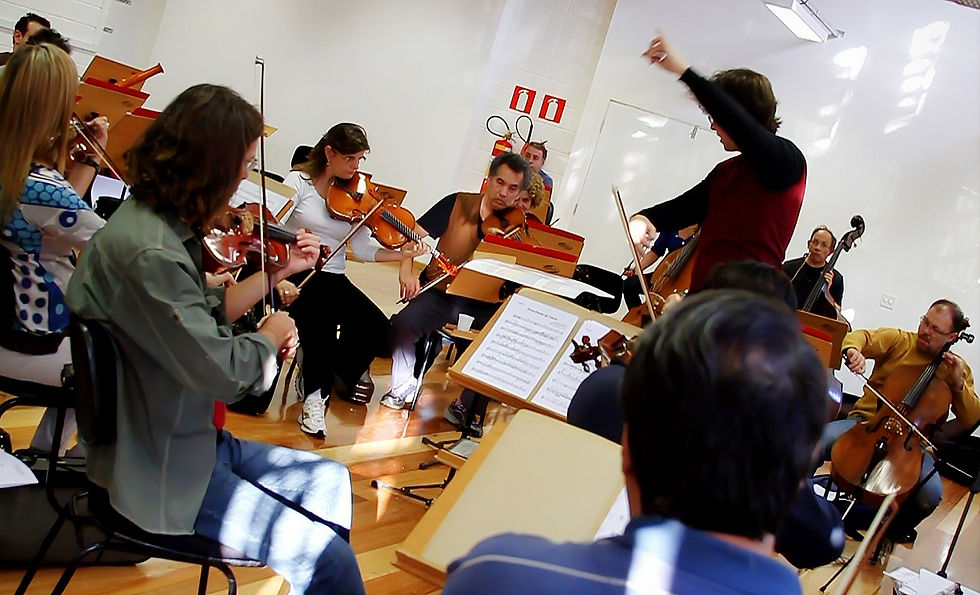
Completing the score begins a new stage of the process. In rehearsals, the decisions made during the writing come into contact with the orchestra's sonic reality.

Rehearsals can reveal aspects that were not anticipated during the writing. Even with sophisticated orchestral simulation software, nothing replaces a real orchestra performing the work for the first time.
Example: Voa Hermeto, from Premiere to Recording
I experienced this recently with Voa Hermeto. The piece was premiered by Orquestra Urbana at Sala São Paulo and entered the recording studio a few days later. During the rehearsals and performance, I realized that some orchestration choices could work better. I rewrote certain passages, redistributed material between the saxophones and trumpets, and adjusted details with the particular characteristics of the musicians performing the work in mind.

The recorded version was no longer exactly the same as the one presented at the premiere. This kind of revision is part of the journey of many compositions. Rather than ending the process, the premiere often opens a new stage in which the score can be revised and refined as it encounters new performers and new performance contexts.
Example: The Transformations of Inconsciente
Few examples illustrate this process better than Inconsciente, one of my earliest works to receive a version for orchestra.
I wrote this music when I was eighteen. At the time, it existed only as a piece for a small instrumental ensemble, a lead sheet performed by the Brazilian instrumental music quartet I had formed during my first year of music school. Soon afterward, an unexpected opportunity emerged.
Clóvis Beltrami, who had been my trumpet teacher before I entered Unicamp, also taught the instrument at the university and served as principal trumpet of the Campinas Municipal Symphony Orchestra and Big Band Canavial. He told me about a special concert that would bring the two groups together and asked whether I had a composition that might work in that context.
I did not, at least not for that instrumentation. But I recognized an opportunity. I rewrote the piece for big band and orchestra, submitted the score, and the conductor decided to include it in the program.
That was how my first professional symphonic premiere came about. I was in my first year of college, both excited and apprehensive about the scale of the opportunity.
Ciro Pereira was in the audience on the day of the performance. He was one of the most important figures in the history of writing for large ensembles in Brazil and one of the central names associated with the Brasil Jazz Sinfônica. After the concert, I was introduced to him and received generous comments about the work.
The story, however, did not end there. Over the years, Inconsciente went through a series of transformations. The piece began as a composition for a small instrumental ensemble (2004), received a version for big band and orchestra that same year, and was revisited for my Unicamp graduation concert (2011). In the years that followed, it was presented again in projects connected to the University of Miami, selected for a Brasil Jazz Sinfônica composition competition (2015), given a big band version premiered in a NY Jazz Composers' Mosaic concert in New York (2019), included in Forró Sem Palavras Sinfônico in Campinas (2019), and newly recorded with Orquestra Urbana in São Paulo (2025).


Each new performance brought changes, revisions, and new musical solutions. Most recently, the work was revisited for Orquestra Urbana and went through further adaptations before arriving at the version that is part of my current body of work.
The music I wrote at eighteen is still alive, although it is no longer exactly the same. Some works continue to change for years. The premiere is an enormously important milestone in the life of a composition, but it does not necessarily mean that the work has reached its definitive version.
After the Premiere: The Challenge of Circulation
A premiere begins the public life of a work, but it does not guarantee that the music will continue to circulate. Very few compositions become consistently established in the repertoire of different orchestras.
In many cases, the future of a work depends less on its musical quality than on the circumstances surrounding it. The existence of a recording, the interest of a soloist, the support of a conductor, the involvement of an institution, or favorable programming can determine whether a composition continues to circulate or disappears after its premiere. For this reason, the circulation of new works remains one of the great challenges in the career of a contemporary orchestral composer.

→ CONTINUE READING: Contemporary Orchestral Composer: What Does It Mean to Write for Orchestra Today?
From Commission to Premiere
The paths taken by the Brazilian Concerto for Tuba and Orchestra, Voa Hermeto, and Inconsciente demonstrate different ways in which a work can reach the stage. In the first case, the commission established the framework for the creative process. With Voa Hermeto, the rehearsals and premiere led to revisions before the recording. With Inconsciente, an initial opportunity opened a process of transformation that extended across more than two decades.
In all of these cases, the score occupies a central place, but it does not contain the work's entire story. The creative process is also shaped by the conditions of the project, the dialogue with performers, and what emerges during rehearsals and performances. The premiere moves the composition into the public realm and may mark the beginning of new revisions, interpretations, and possibilities for circulation.
Continue Exploring
About the Author
Rafael Piccolotto de Lima is a composer, arranger, music director, and educator. A Latin Grammy-nominated composer and recipient of multiple international awards, including 13 DownBeat Awards and honors from ASCAP, he develops artistic projects at the intersection of Brazilian music, jazz, and orchestral writing. His work also encompasses recording production, research, education, and interdisciplinary collaboration.


Comments