
Contemporary Orchestral Composer: What Does It Mean to Write for Orchestra Today?
- Rafael Piccolotto de Lima

- Jul 7
- 9 min read
Updated: 6 hours ago
When we think of an orchestral concert, we naturally tend to picture works by composers such as Bach, Mozart, Beethoven, Mahler, Stravinsky, or Villa-Lobos - some of the defining figures in the history of the classical concert tradition.
For many people, concert music seems to belong almost entirely to the past. There is even a widespread impression that orchestras no longer perform new works and that there are hardly any composers still writing for this repertoire.
That perception is understandable. Most major orchestras continue to devote the majority of their seasons to the historical repertoire, particularly works composed between the eighteenth century and the early twentieth century. Although new compositions continue to be written every year, they still occupy only a relatively small portion of most orchestral programs.
This also means that the number of composers who are able to write regularly for professional orchestras remains quite small. Universities and conservatories continue to train new composers every year, yet only a few go on to build sustained careers in this highly specialized field, with their works being performed by different institutions and appearing regularly in orchestral seasons. This article explores that reality and what it means to work as an orchestral composer today.

The concentration of composer training within academic institutions also helps explain why so many contemporary works emerge from that environment and why a significant portion of today’s orchestral output remains connected to the aesthetic traditions that developed there. At the same time, this tells us very little about what it takes for a new work to move beyond that world and become part of the repertoire of professional orchestras.
That is where the profession takes on another dimension. Writing music remains at the heart of a composer’s work, but composing is only one stage of a much broader process. The few composers who succeed in building lasting careers must also create projects, develop collaborations, and build the relationships that make it possible for new works to be performed and to continue circulating. That is the less visible side of orchestral composition that I hope to explore in this article.


Building a Career as an Orchestral Composer
Although this educational environment continues to play a fundamental role in training new composers, it represents only the beginning of the journey. Moving from academic training to a sustained professional career is considerably more challenging.
I developed much of my own musical education within that environment, first at UNICAMP and later at the University of Miami, where I served as a Composer Fellow at the Henry Mancini Institute. That experience also allowed me to observe firsthand many of the challenges involved in building a career devoted to writing for orchestra.


At the same time, this environment also reveals one of the profession’s central challenges. Although many composers graduate every year, opportunities to write regularly for professional orchestras remain limited. A premiere is only one step in the process. Having a work performed again by different institutions is often an even greater challenge.
For that reason, mastering compositional technique and developing a distinctive artistic voice, while essential, are not enough to sustain a career as a composer. Transforming ideas into works that actually find performers, institutions, and opportunities for future performances requires a set of skills that extends well beyond the act of writing music.
Who Commissions New Works?
There is no single path through which a new orchestral work comes into being. Throughout my career, some compositions have originated as commissioned works, while others began as personal artistic projects and only later found their first performers.
Raiar was written for an anniversary concert presented by the Symphony of the Americas. Abertura Jobiniana grew out of a commission from the National Symphony Orchestra of Costa Rica for a program dedicated to the music of Tom Jobim. More recently, I wrote the Brazilian Concerto for Tuba following an invitation connected to the work of tubist Patricio Cosentino, who has been actively expanding the Latin American repertoire for his instrument.

In other cases, the initial impulse came from my own artistic interests. Fantasia Gismontiana emerged from a desire to explore the musical universe of Egberto Gismonti while bringing together colleagues from the Frost School of Music to bring that project to life. Cenas Quiméricas began as an orchestration assignment and eventually premiered as the opening work of the 2014 season of the Campinas Municipal Symphony Orchestra. Sete Máscaras grew out of my doctoral research on the intersections between jazz language and concert music.
Even when the initial idea comes from the composer, however, the prospect of a future performance is usually part of the creative process. Writing for orchestra requires a significant investment of time and energy, and the possibility of hearing that music brought to life by an orchestra naturally influences which projects are worth pursuing.
From Composition to Premiere
There is often an assumption that a composer’s work ends when the score is finished. In practice, completing the manuscript marks the beginning of a different stage in the process. Preparing the performance materials, rehearsing, discussing the work with musicians and conductors, making revisions based on rehearsals, and finally presenting the premiere all come afterward.

In many cases, the first performance is not the end of the story. Rehearsals and early performances offer the composer a new perspective on the work itself. Hearing the music performed may inspire new ideas, confirm certain artistic decisions, or reveal opportunities to revise different aspects of the composition.
As I write this article, for example, I am revising my Brazilian Concerto for Tuba after its premiere performances in Brazil, preparing the work for future international performances. This kind of revision is part of the life of many compositions. The musical idea imagined during the writing process remains the same, yet the experience of hearing it realized also gives rise to new reflections.
The Conductor’s Role
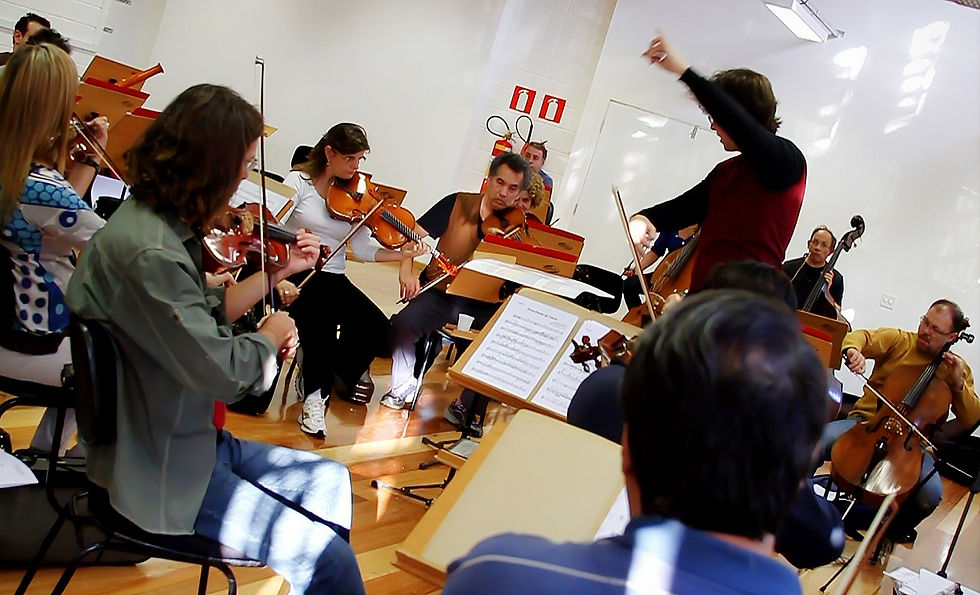
When a new work reaches its first rehearsal, everyone is encountering something unfamiliar. The musicians are reading the score for the first time, the conductor is shaping an interpretation, and, unlike works from the historical repertoire, there are no existing recordings or established performance traditions to serve as reference.
In that context, the conductor’s role becomes especially important. The artistic decisions made during rehearsals directly influence how the audience will experience the work. In many cases, that first interpretation establishes reference points that may continue to shape future performances of the piece.

The Challenge of Keeping a Work Alive
As I mentioned earlier, writing an orchestral work is only one of the challenges composers face. Ensuring that it continues to be performed after its premiere is another challenge of equal importance.
Most orchestras build their seasons around an established repertoire. Works by composers such as Beethoven, Mozart, Brahms, Mahler, Tchaikovsky, Ravel, and Stravinsky continue to occupy a central place in concert programming, while premieres and commissioned works make up only a relatively small portion of most seasons.
As a result, many contemporary works receive only a single performance. Some are performed a second time, but relatively few become part of the regular repertoire of different orchestras. That is one of the reasons why the continued circulation of a work is just as important as its premiere, a subject I discuss in greater depth in the article Why Do Orchestras Perform Only Dead Composers?
For a living composer, seeing the same work performed by different institutions over the years is one of the clearest signs that it has begun to establish a life of its own.


A Deeper Question
There is, however, a broader issue at stake.
Throughout the twentieth century, much of contemporary concert music increasingly embraced aesthetic innovation, experimentation, and a deliberate break with earlier traditions. This movement made fundamental contributions to the expansion of musical language, but it also profoundly changed the way many composers approached their work.
In many academic settings, composers came to be encouraged to develop a musical language clearly distinct from both the historical tradition of concert music and the languages of popular music. Within this environment, composition became increasingly connected to artistic research and to particular aesthetic currents within contemporary concert music.
The result was the consolidation of a highly specialized artistic environment. This process significantly expanded the possibilities of musical composition and gave rise to works and research of enormous importance to contemporary music. At the same time, it also contributed to widening the distance between part of this repertoire and the aesthetic experience of most listeners.
It is therefore not surprising that many of these works struggle to circulate beyond universities, specialized festivals, and other spaces dedicated to contemporary concert music.
Meanwhile, audiences continued to build their musical references elsewhere - through popular music, film scores, jazz, regional traditions, and the new forms of music-making made possible by technological change. For most people, the orchestral world is already somewhat removed from everyday life. When that distance is combined with a musical language deliberately designed to move away from familiar references, the gap can become even greater.
One of the most interesting challenges facing contemporary orchestral composition, in my view, is finding ways to engage audiences without abandoning either the richness of the symphonic tradition or the freedom to continue expanding the possibilities of musical language.
New Paths for the Orchestra
In 2024, I was invited to conduct the main concert of the Brazilian Contemporary Music Festival, one of the country’s leading events dedicated to new concert music. The program itself revealed an interesting perspective on some of the possible directions contemporary composition can take.
The concert brought together two composers honored at that year’s festival whose artistic paths had developed in very different contexts. On one side was the music of composer Kilza Setti, whose work is closely associated with the concert music tradition. On the other was the music of João Bosco, whose career was built within Brazilian popular song. Presented within the same concert, both were recognized as part of a broader panorama of contemporary Brazilian musical creation.


Although their aesthetic approaches were quite different, both occupied the same space celebrating contemporary musical creation. That encounter highlighted a tension present throughout much of today’s orchestral world: on one side, the concert music tradition developed primarily within academic institutions; on the other, creators whose work emerges from popular music, songwriting, and other musical practices equally committed to creating new music.
The program demonstrated how these different traditions can engage in dialogue, a question that is closely connected to my own research. It suggests that one of the most interesting questions in contemporary orchestral composition is not where concert music ends and popular music begins, but how different traditions can contribute to expanding the possibilities of writing for orchestra.
I have seen this same movement reflected in many of the projects I have been involved with over the years.
What Does It Mean to Compose for Orchestra Today?
If there is one conviction I take away from my own experience, it is that writing music remains at the heart of a composer’s work. Throughout my career, however, I have come to recognize with increasing clarity the importance of the ecosystem that makes the creation, performance, and continued life of an orchestral work possible. The score represents only one stage of that journey. Composing also means understanding how orchestras, performers, conductors, institutions, and artistic projects come together, and learning how to build the conditions that allow music to find its place within that ecosystem.
I believe orchestras have two equally important responsibilities. At the same time that they preserve one of the greatest artistic legacies in the history of music, they can also remain open to new repertoire and to the work of living composers. These two roles are not in conflict. It is through the balance between preservation and renewal that the orchestral tradition remains alive and continues to find new ways of engaging with its own time.
About the Author
Rafael Piccolotto de Lima is a composer, arranger, music director, and educator. A Latin Grammy-nominated composer and recipient of multiple international awards, including 13 DownBeat Awards and honors from ASCAP, he develops artistic projects that connect Brazilian music, jazz, orchestral writing, improvisation, recording production, research, education, and interdisciplinary collaboration.



Comments