
Why Create a Composer-Led Big Band Today? The Story of Orquestra Urbana
- Rafael Piccolotto de Lima

- 1 day ago
- 14 min read
Creating a composer-led big band today seems, in many respects, like an impractical decision.
The format is expensive, logistically complex, and demands a significantly greater level of organization than most musical groups face. Rehearsals require suitable spaces, schedules must be coordinated, and every performance requires a substantial operation involving musicians, production, and music preparation.

At the same time, a large acoustic ensemble has not been necessary for producing complexity, volume, or impact for many decades. Electric instruments, keyboards, microphone techniques, and amplification systems have long allowed smaller groups to build dense and varied sonic worlds. Digital technologies have radically expanded this field through sound libraries, layering techniques, and increasingly sophisticated production resources. Mass, impact, and sonic variety can now be achieved in many ways.
The distinction between what can be achieved in the final result and the particular value of a chosen process also exists in filmmaking. A director may choose to shoot on location and work with practical effects even when digital tools could construct those images in another way. This choice neither rejects technology nor establishes a hierarchy between the results. It recognizes that the way something is made affects the creative experience and leaves its mark on the character of the work.
In this sense, choosing a big band cannot be explained solely by the final sound. It involves the particular character of the formation, the experience of writing for it, and the artistic and human process that takes place when those musicians come together to bring the music to life.
Recognizing that value, however, does not settle the question. What leads someone to create a big band devoted to original music and to continue investing time, energy, and resources in it for more than a decade?

I am rarely asked this question so directly. It tends to surface between the lines when colleagues say they are impressed that we can bring together a group of this size or express admiration for anyone willing to take responsibility for organizing and sustaining a big band. It also accompanies my own relationship with Orquestra Urbana. Because I know firsthand the production challenges, costs, and energy required to sustain a project like this, it is natural for me to ask why I continue investing so much in making it possible.
This is not a doubt that makes me step back, but a question that remains in the air and accompanies the work itself. The answer runs through the history of Orquestra Urbana, but it also touches on broader questions about artistic creation, human collaboration, and the desire to build spaces where certain ideas can exist.
→ Read more: Building a Musical Language of My Own: Revisiting Pelos Ares, My First Album with Orquestra Urbana
What Is a Big Band?
When we speak of a big band, we are usually referring to the formation that became established within the jazz tradition over the course of the twentieth century.

As an analogy of scale, a big band occupies a place in jazz comparable to that of the symphony orchestra in concert music. The comparison is not about instrumentation, but about the size of the formation and the possibilities it offers for writing. Alongside the strong tradition of duos, trios, quartets, and quintets, the big band brings this language to a larger scale, organized into sections of saxophones, trumpets, and trombones, along with a rhythm section.
Historically, the big band tradition is associated with figures such as Duke Ellington, Count Basie, Thad Jones, Bob Brookmeyer, and Maria Schneider, among many other composers, arrangers, and bandleaders who helped expand the possibilities of writing for large ensembles.
Although the big band became established within American jazz, its presence in Brazil cannot be reduced to the adoption of a foreign model. By the time jazz bands began to spread throughout the country, Brazil already had a musical culture shaped by military and civilian bands, Carnival formations, salon orchestras, and small choro groups. As the format took root in Brazil, it began to coexist and interact with local repertoires, musicians, and practices, gradually incorporating different elements of Brazilian music.
I have never viewed this formation as limited to the repertoire and language of jazz. Starting from that tradition, the big band can serve as a meeting point with other musical worlds. For me, its richness lies precisely in the possibility of using composition, arranging, and improvisational practices to establish dialogues with different traditions, including those of Brazilian music.
Why Create a Composer-Led Big Band?
If someone asked me today why someone might create a big band devoted to original music, I would probably say that there are many possible reasons, but five have been especially important in my own path.
1. A different way of thinking about writing
The scale of a big band creates particular possibilities for writing. Distributing voices across sections, opening up harmonies, layering textures, creating contrasts between sections, and shaping large masses of sound require a different way of thinking from the one used for a quartet or quintet. The appeal lies not only in the sonic result, but in the experience of conceiving music for this formation.

2. Continuity for developing a compositional voice
There is an important difference between writing occasionally for a formation and having a group that can follow your ideas over many years. A composer-led big band makes it possible to test approaches, revise works, refine processes, and observe how a compositional language develops over time.
3. An identity built collectively
Although the composer often receives the attention, much of a big band's richness emerges from the interaction among its musicians. The ways soloists improvise, the choices made by the rhythm section, and the particular approaches to interpretation developed within each section all influence the music. Over time, the group's identity comes to reside not only in the scores, but also in the people who bring them to life.

4. Artistic autonomy
A self-directed project makes it possible to choose collaborators, set priorities, develop repertoire over the long term, and pursue directions that might not find a place within established structures. This autonomy allows artistic decisions to respond to the needs of the work, even when they do not align with the expectations of an institution or an established group.
5. A space for ideas that have not yet found a home
Some ideas need a space of their own in order to exist. Not every piece of music finds a natural home in existing institutions or formations. In many cases, creating a big band is less a matter of ambition than an attempt to build an environment where certain questions can be explored.
Together, these reasons help explain both the emergence of Orquestra Urbana and its continuity over the years.
From the Experience of Playing to the Desire to Create a Big Band
The reasons presented above began to take shape long before the creation of Orquestra Urbana, through my experiences with large ensembles.
Even as a teenager, I was already fascinated by the world of orchestras and big bands. I enjoyed listening to those masses of sound, trying to understand what was happening inside them, and noticing how different instruments could combine to create something greater than the sum of their parts.
During my years at Unicamp, I began playing regularly in big bands as a saxophonist and was able to experience this music from within. The sound came from different directions, the sections breathed together, articulations happened collectively, and the sections moved like living organisms. It was not simply a matter of hearing a large formation, but of taking part in a musical realization built through the interaction of many people.
During that same period, encountering the work of Maria Schneider and Nailor Azevedo “Proveta” added another dimension to this experience. Their big bands spoke in very different musical languages, but both showed how the identity of a formation also develops through an ongoing relationship between the writing and the individual qualities of the musicians.

For the question guiding this article, the central point lies in that continuity. I was interested not only in writing occasionally for a big band, but in following what might happen when works were rehearsed, performed, revised, and interpreted again by musicians who developed an enduring relationship with the repertoire.
The experience of playing within these formations and the desire to sustain an ongoing environment for creation helped lay the foundations for Orquestra Urbana. Creating the big band would bring together these two dimensions: the particular possibilities of writing for large ensembles and the musical development that takes place through sustained collaboration among musicians.
Artistic Autonomy in Practice: Why Not Simply Write for Other Groups?
Two of the reasons presented earlier for creating a composer-led big band are especially closely related: the pursuit of artistic autonomy and the need to build a space for ideas that have not yet found a home. The significance of this distinction becomes clearer when we consider another important dimension of my work: writing for groups and institutions with histories of their own.
Throughout my career, I have had opportunities to write for universities, orchestras, big bands, artists, and a range of projects. I continue to do so. Each commission establishes a particular context and can open possibilities that would be difficult to encounter in any other way.
At the same time, anyone writing for an established formation enters an environment with its own identity, repertoire, priorities, working practices, and relationships with its musicians and audiences. This does not necessarily constitute a limitation, but it does mean that the work enters into dialogue with conditions that predate its creation.
During my doctoral research, I had the opportunity to interview Greek-born, New Zealand-based composer John Psathas. Among many subjects, we discussed the challenges of developing an artistic voice within established structures.

I remember him commenting that established groups often have very specific repertoires, audiences, habits, and expectations. A musical idea may be entirely feasible and still fail to find a natural place in that context. The issue does not necessarily lie in the openness of the musicians or institutions, but in the compatibility between the artistic proposition and the existing environment.
The conversation helped articulate a difference I also recognized in practice. When I write for another group, I develop the music in dialogue with a structure that already has its own history. In a composer-led project, it is possible to build that structure gradually around the artistic questions I want to explore. The repertoire transforms the group, while the experience accumulated by the musicians also transforms the repertoire.
In this sense, artistic autonomy and collaborative creation are not opposing ideas. Creating a space of one's own does not mean controlling every result alone, but establishing the conditions in which particular ideas can be developed collaboratively over time.
This autonomy comes at a cost. Anyone who leads a self-directed project assumes responsibilities that, in other contexts, would be distributed among institutions, producers, artistic directors, and conductors. The ability to determine the direction of the work comes with risk, an operational burden, and the responsibility of creating the conditions for the project to exist.
For certain kinds of creative work, however, this still seems like the most natural path.
The Origins of Orquestra Urbana
Orquestra Urbana began in 2014, when I was already living outside Brazil. It emerged at the intersection of two worlds that had been shaping my path: on one side, my education and immersion in jazz and large ensemble writing in the United States; on the other, my deep connection with the musicians, languages, and traditions of Brazilian music. From the beginning, the group served as a space where these influences could interact.
The opportunity came through an invitation to participate in a big band project in Campinas, my hometown. The initial idea was relatively simple: bring musicians together to perform my compositions as part of that concert series.

Although I am identified as the founder of Orquestra Urbana, the truth is that it emerged from a collective effort. Trumpeter João Lenhari, a longtime friend and one of the principal organizers of that first encounter between my work and musicians connected to Banda Urbana and São Paulo's instrumental music scene, played a fundamental role in the process. Without his enthusiasm, his ability to bring people together, and his trust in the project, the history of Orquestra Urbana would probably have followed a different path.

A smaller group called Banda Urbana already existed. From it came the idea of expanding the formation, bringing in new musicians, and building something larger. What started as a concert quickly began to feel like the beginning of a band.
I clearly remember the energy of those first gatherings. On one hand, I had the opportunity to work with musicians I admired deeply and whose careers I had followed for years. On the other, there was genuine curiosity surrounding the repertoire and the artistic vision I was bringing.

When I think back on that period, what I remember most is not only the musical quality of those encounters, but the enthusiasm. There was a sense that everyone involved believed they were helping build something new and worthwhile. This kind of energy is difficult to plan. It simply emerges when the right circumstances meet the right people.
Orquestra Urbana as a Creative Laboratory
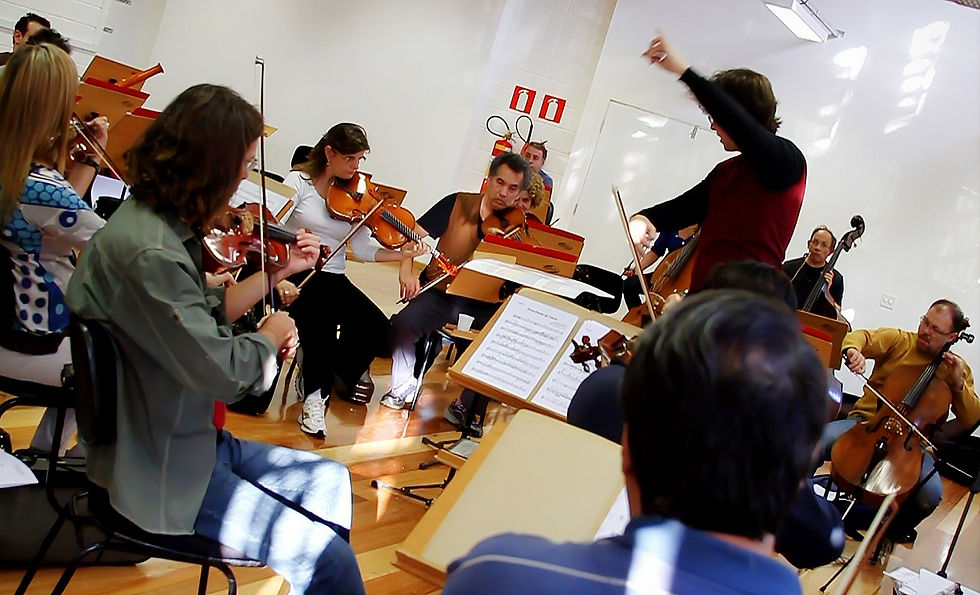
From the first rehearsals, Orquestra Urbana functioned as a laboratory for developing the works. The scores did not arrive as immutable materials. The musicians joked that a new version appeared every week, and there was a great deal of truth in that observation.
I recorded the rehearsals, listened to them at home, and returned to the writing. Sometimes I made small orchestration adjustments; at other times, I reshaped entire sections, created new backgrounds, made cuts, or expanded particular passages.

Performances also fed this process. An idea that seemed to work on the page could reveal a different reality when it encountered the musicians' interpretations, the soloists' improvisations, and the audience's response. Likewise, an interpretation could reveal possibilities I had not anticipated during composition.
This cycle made Orquestra Urbana an important part of my practical education. In addition to developing my writing for large ensembles, I had to learn how to prepare music, lead rehearsals, make decisions in real time, and turn what I heard into new versions of the works.
Pelos Ares and the Consolidation of the Project
Not long after the debut concert, an opportunity arose that would change the course of Orquestra Urbana. The project was selected through a ProAC grant program. ProAC, the Programa de Ação Cultural, is a funding initiative of the São Paulo state government. This support made it possible to record Orquestra Urbana's first album.

Rather than going directly into the studio, we developed the repertoire over several months of rehearsals and performances. During that period, the works continued to change, the interpretations evolved, and the musicians' contributions became more deeply embedded in the project's identity.
When we entered Estúdio Sincopa in 2015, the music already carried the experience accumulated through those encounters. The recording did not represent the beginning of the process, but the consolidation of repertoire that had been developed collectively.

Pelos Ares documented a specific moment in my trajectory and in the identity Orquestra Urbana was beginning to develop. The album brought together musicians including Brian Lynch, John Daversa, Phil Doyle, André Mehmari, Nailor Azevedo “Proveta,” and Paulo Braga, while giving recorded form to the collective process that had begun in those first encounters in Campinas.

The Challenge of Continuing
When Orquestra Urbana began in 2014, my attention was focused on building relationships with the musicians and making that first concert happen.

The album recording, the performances that followed, and the new compositions gradually expanded the project. Its continuity did not result from a predetermined plan, but from the possibility of returning to the repertoire and bringing the musicians together again when new opportunities arose.
This process always involved financial constraints, rehearsal spaces, the schedules of nearly twenty people, and changes in the participants' professional lives. Because I was already living outside Brazil, each new phase also required planning from a distance, travel, and the involvement of collaborators who were present in the daily life of São Paulo's music scene.
Across these different phases, some musicians remained for many years, while others participated at particular moments. In every case, the orchestra's continuity depended on people willing to invest time, energy, and genuine interest in a project that could not be justified solely on practical grounds.

Their willingness allowed Orquestra Urbana to develop as an artistic community committed to exploring the repertoire collectively, even when circumstances made it impossible to maintain a continuous schedule of activities.
The Return and a New Cycle
After the recording of Pelos Ares and the projects undertaken in the following years, the orchestra's activity naturally became less frequent. My life had changed, I was established in New York, and new professional projects increasingly occupied my schedule. At the same time, the very nature of a big band makes it difficult to sustain continuous activity without a permanent institutional structure.
Then came the pandemic, interrupting performances, rehearsals, and virtually every in-person activity involving large ensembles.
When the orchestra began resuming its activities more consistently in 2023, I had a curious feeling. Many things remained familiar. Some of the musicians who had participated in the early years were still present, certain qualities of the band's sound were still recognizable, and the working process followed a similar logic. At the same time, this was clearly a new moment.


New musicians joined the group, new works began entering the repertoire, new projects emerged, and I was no longer the same composer who had written those first pieces in 2014.
The return also reactivated a less visible dimension of a self-directed project like this. Knowing that there is a group capable of receiving new works, musicians interested in developing them, and performances in which they can come to life creates a concrete horizon for writing. Orquestra Urbana was not merely a destination for music I had already composed. The prospect of reuniting with the musicians and building new repertoire with them also became a driving force for continuing to create.
This new phase took shape through projects and performances in a range of settings, including SP Instrumental, Sociedade Hípica de Campinas, and Sala São Paulo. It also includes Orquestra Urbana's role as the house band for the second edition of the Concertos Contemporâneos series at Sesc Pinheiros, as well as the recording sessions for the new album.
Although the context was new, the return preserved the orchestra's central role as a space for developing repertoire. Many works on the second album went through rehearsals, public performances, and revisions before reaching their recorded versions, allowing this new phase to continue the process begun during the project's early years.
What Orquestra Urbana Represents Today
When I think about Orquestra Urbana today, I find it difficult to define it simply as a band. Over the years, it has become an important part of how I develop my artistic work.

Many ideas that emerged during my studies in the United States found a space for experimentation in Orquestra Urbana, while my ongoing work with Brazilian musicians continued to bring references, repertoire, and ways of thinking that would have been unlikely to emerge in another context.
The orchestra thus became a meeting point between different parts of my artistic life: Brazil and the United States, Brazilian music and contemporary writing for large ensembles, the detailed planning of composition and the creative freedom of the musicians who interact with that material.
After more than a decade, I continue returning to the project because it allows me to hear an idea take on a collective form, be transformed by the performers, and produce something none of us would build alone.

This is the most direct answer to the question that gave rise to this article. Creating a composer-led big band was never a decision based on efficiency, but on the value of sustaining a space in which certain musical experiences could unfold over time. Orquestra Urbana grew out of that desire, and each new body of work carries forward the collective process that motivated its creation.
Listen to the Album

About the Author
Rafael Piccolotto de Lima is a composer, arranger, music director, and educator. A Latin Grammy-nominated composer and recipient of multiple international awards, including 13 DownBeat Awards and honors from ASCAP, he develops artistic projects that connect Brazilian music, jazz, orchestral writing, improvisation, recording production, research, education, and interdisciplinary collaboration.


Comments