
The Composer’s Role in Realizing an Artistic Vision
- Rafael Piccolotto de Lima

- Jul 11
- 10 min read
Updated: 3 hours ago
When we think of the great composers of history, we naturally think of their works.
We think of works such as Johann Sebastian Bach’s The Well-Tempered Clavier, Mozart’s operas and concertos, and Gustav Mahler’s symphonies. In Brazilian music, we remember Villa-Lobos, Tom Jobim, and Hermeto Pascoal. In jazz, we think of composers such as Duke Ellington, Thad Jones, and Maria Schneider.
Each of them developed a distinctive musical language and found a particular way to build a career. Yet when we examine these careers more closely, a shared characteristic emerges across very different periods, styles, and contexts.
Composition rarely exists as an isolated act. In many cases, it is part of a much larger creative process.
Before the first note exists, there is often already an instrumental configuration, a group of musicians, a developing sound, an artistic context, or a question guiding the creative process. After the music has been written, that process continues to take shape through rehearsals, revisions, recordings, performances, collaborations, institutions, and new projects.

Each composer followed this path in a different way. Bach developed much of his work within the intense musical life of the Lutheran Church. Mahler balanced composition with the direction of major European opera houses. Villa-Lobos brought together composition, conducting, music education, and cultural projects. Hermeto Pascoal developed a musical language inseparable from his work as a multi-instrumentalist, improviser, and bandleader. Maria Schneider shaped her language over decades at the helm of her own orchestra. Vince Mendoza made collaboration with artists, big bands, and orchestras a central part of his writing.
The differences between these careers are clear. What stands out is that, in each case, someone assumed, to a greater or lesser degree, the task of turning an artistic vision into reality.
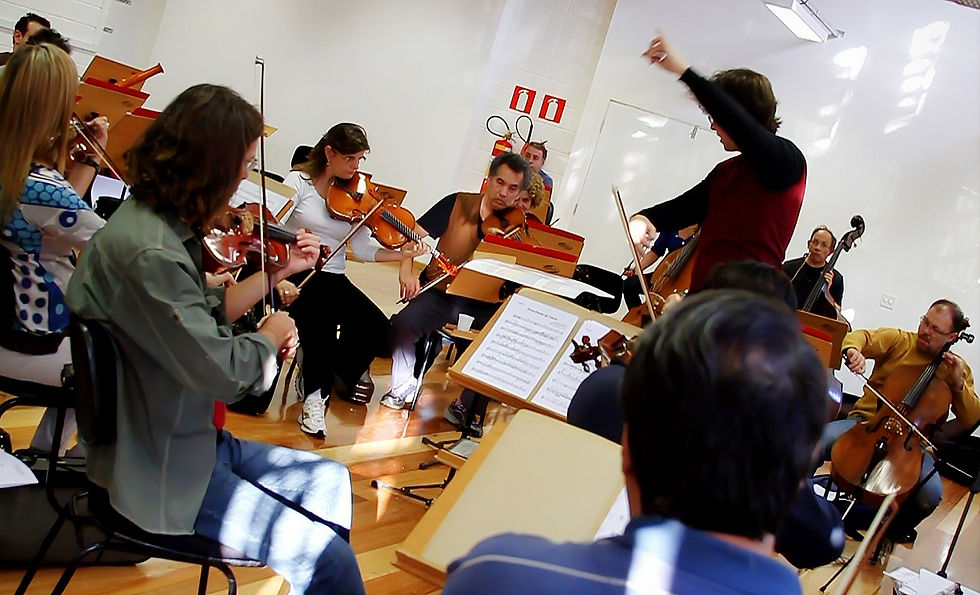
A score records part of this journey, but it can hardly capture everything that made the music possible. It does not show the group that had to be formed, the artistic relationships cultivated over the years, the rehearsals that transformed a work, the institutions that sustained a project, or the choices that allowed the music to find its performers and its audience.
One of the less frequently discussed dimensions of composition lies in the distance between music as written and music as realized.
Composition as Part of a Larger Process
Looking at these careers, it becomes clear that there is no single model for how a composer should work. Each artist built a musical world in a different way. In some cases, that world developed within major institutions; in others, it grew from permanent groups, long-term partnerships, or artistic communities built over decades. Some composers found this path primarily through conducting; others through performance, collaboration, or the creation of projects.
Johann Sebastian Bach offers one of the clearest examples of this integration. His routine in Leipzig extended far beyond writing music. In addition to composing continuously for the liturgical calendar, he rehearsed choirs and instrumentalists, trained musicians, organized the musical activity of the churches under his responsibility, and directed performances. Composition was part of a much broader daily musical practice.
Mozart lived in a completely different reality. As an independent composer in Vienna, he organized concerts, performed as a pianist, sought commissions, cultivated relationships with patrons, and closely followed the circulation of his works. Writing music was only one part of his professional life.
In Gustav Mahler’s case, it is difficult to separate composition from artistic direction. While developing his work as a composer, he also directed the Vienna Court Opera, devoting extraordinary attention to interpretation, rehearsals, dramaturgy, and repertoire. Both activities occupied a central place in his career at the same time.
In Brazilian music, the same principle appears in different forms.
Heitor Villa-Lobos left behind one of the largest bodies of work in Brazilian music. He also helped develop public policies for music education, directed cultural initiatives, and contributed to the consolidation of institutions that significantly expanded the reach of his artistic work.
Tom Jobim developed his music through an ongoing dialogue with performers, arrangers, recording studios, and creative partners. Throughout his career, he also presented this music as a pianist, singer, and leader of his own groups, participating directly in the way his compositions reached the public.
Hermeto Pascoal represents a particularly vivid example of this integration between creation and realization. His group became a permanent laboratory for experimentation, where new ideas were continually tested, transformed, and developed. His musical language can hardly be understood without considering this creative environment.
Naturally, none of these artists followed the same path. It would be impossible to reduce such different careers to a single professional model. What they share is not a specific role, but a willingness to follow the development of a musical world far beyond the moment when the music begins to be written.

How This Practice Continues Today
This pattern also appears frequently in contemporary professional practice. Among composers whose music regularly circulates through groups, festivals, orchestras, and institutions, writing often develops alongside the creation of collaborations, projects, and contexts capable of sustaining that artistic work.
Today, there is rarely a structure simply waiting for a new piece. In many cases, composers participate in creating the environment in which their music can develop. This may mean building a permanent group, establishing long-term collaborations, developing relationships with particular institutions, or bringing different musicians together around a shared artistic vision.
It was by observing this generation that I began to recognize this pattern more clearly.
Maria Schneider is often described as one of today’s leading composers for big band. That description is accurate, but it says little about the way her music was built. Over more than three decades, her musical language developed through an ongoing dialogue with the same orchestra. Rehearsals, performances, recordings, tours, and sustained relationships with those musicians gradually transformed both the ensemble and the writing itself. In this context, the big band is no longer simply the group performing the music. It becomes part of the compositional process itself.

Vince Mendoza followed a different but equally revealing path. Rather than developing his language through a single group, it took shape over decades of collaboration with artists, orchestras, and large ensembles from different countries. His work with the Metropole Orkest is perhaps one of the clearest examples of this practice. There, composition, arranging, music direction, and institutional collaboration ceased to function as separate activities and began to continually inform one another, expanding the possibilities of each new project.
This diversity remains present among composers closer to my own generation. Miho Hazama has built an international career in which composition, music direction, and collaboration with different musical groups continually inform one another. Remy Le Boeuf moves naturally between composition, performance, recording, and projects developed in partnership with arts institutions. Although each follows a distinct path, both illustrate how musical creation remains deeply connected to the construction of the environments in which it takes place.

Each career finds its own way of realizing an artistic vision. Composition remains at the center of the creative process, but the musical world it imagines almost always depends on people, groups, institutions, and projects in order to come into existence.
A Practice Built Around Projects
Looking back at my own career, I can see that my interests in different forms of musical work eventually converged into a single artistic practice. Composition, performance, arranging, music direction, conducting, production, and education were never independent goals. Over the years, these activities became different ways of realizing the projects and musical worlds I wanted to develop.
I have always been fascinated by the idea of imagining particular musical worlds. Sometimes the process began with a musical idea. At other times, it began with a sound, an instrumental configuration, an encounter between musicians, an opportunity for collaboration, or a desire to bring together musical languages that did not normally occupy the same space. In each project, composition found a different point of departure, but it became the means through which that musical world was organized and developed.
This way of bringing different activities together around a single project began to take clearer shape during my studies at UNICAMP. Because I was pursuing degrees in both Composition and Brazilian Popular Music, I found myself in a somewhat unusual situation. While the Popular Music program required a graduation recital, the Composition program did not have the same tradition. Rather than seeing these moments simply as academic requirements, I began to use them as opportunities to develop artistic projects I wanted to realize.
The first concert, held in 2009, brought together three groups that represented different aspects of my work at the time: Caruá, devoted to the dialogue between chamber music and Brazilian regional music; the Rafael de Lima Quartet, focused on experimentation within contemporary Brazilian music; and Coletivo Orquestral, a big band directed by Professor Mário Campos, where I had the opportunity to conduct some of my compositions. The graduation recital became an opportunity to bring distinct projects together around a shared artistic proposal.


Two years later, before moving to the United States to begin my master’s degree at the University of Miami, another opportunity arose to expand this idea. At the time, I was completing a FAPESP-funded undergraduate research project on the musical language of the Brazilian big band, had recently had my first symphonic work premiered by the Campinas Municipal Symphony Orchestra, and was preparing to begin my studies at the University of Miami.
Rather than treating each of these experiences separately, I proposed a concert that would bring together the UNICAMP Symphony Orchestra, Coletivo Orquestral under the direction of Professor Mário Campos, my research, and the repertoire I had been developing. None of these initiatives had been created for the concert. The project consisted of bringing them together around a shared artistic vision.


Several years later, Orquestra Urbana emerged from another convergence. While completing my doctorate at the University of Miami, I was writing regularly for large ensembles, gaining recording experience with the Frost Concert Jazz Band, and developing a body of original work for big band. At the same time, the city of Campinas was creating the Grandes Bandas Grandes series, devoted precisely to this musical world.
Grandes Bandas Grandes created an interesting opportunity to present this repertoire alongside musicians I admired and to bring it into a new artistic context. Beginning with Banda Urbana, the idea emerged to expand that group into a full big band for the concert.


From the beginning, I tried to approach that first performance as the start of a longer journey. We documented performances, produced audiovisual material, expanded the project’s visibility, and created conditions for that initial encounter to lead to new developments.
Recordings from that first concert paved the way for Orquestra Urbana’s selection by ProAC, the São Paulo State Cultural Action Program, for the recording of the album Pelos Ares, and for a series of performances and collaborations featuring guest soloists such as André Mehmari, Paulo Braga, Nailor Azevedo Proveta, Brian Lynch, and John Daversa.
Forró Sem Palavras emerged from a different question, but followed the same logic. What interested me was not simply writing new arrangements for forró, but investigating how that musical language could interact with writing for a small jazz orchestra while still functioning as music for dancing.

The project brought together two areas of my work that had rarely appeared in the same form: on one side, my work as a composer and arranger for large ensembles; on the other, my involvement in the forró community as an educator and cultural producer. The first response to this investigation was a small chamber jazz orchestra in New York. Over time, however, it became clear that the project was larger than that specific instrumentation.
The repertoire began to take on new forms, was performed in cities across the United States, Canada, and Brazil, and later received a symphonic version presented by the Campinas Symphony Orchestra alongside Toninho Ferragutti, Paulo Braga, Edu Ribeiro, and Cleber Almeida. The ensemble, collaborators, and performance contexts changed. The musical world, however, remained the same.
Looking back at these projects today, I see that they share a fundamental characteristic. None began with the intention of founding a group, taking on a particular position, or building a career in a predetermined way. They all began with an artistic idea I wanted to develop and for which I began constructing the necessary conditions for realization.
This is where I find the strongest connection with many of the composers I admire. Our careers are not alike, but we have all found our own ways of transforming musical ideas into artistic projects and creating the conditions that allow them to exist.
Beyond Writing Music
After observing different ways of building a career as a composer, it has become difficult for me to think of a composer’s work simply as the act of writing music.
Writing remains at the center of creation, but it rarely represents the entire process. When a new work begins to take shape, there is almost always something that precedes the score itself: an artistic question, a fascination with a musical world, potential collaborations, a developing project, a creative opportunity, a cultural context, or simply the desire to explore paths that do not yet exist. Composition is one way of giving material form to that world.
The work continues after that. Each composer finds a different way of following the process. Some build groups that develop a shared musical language over decades. Others find that environment within major institutions. Some do so primarily through performance, conducting, music direction, collaboration, or the creation of ongoing projects. In many cases, these activities become part of the process through which the work is realized, creating the conditions that allow the music to exist.
Many of history’s great composers left behind far more than a body of work. They also transformed ways of making music, helped shape artistic communities, influenced generations of performers and composers, and contributed to the creation of environments in which their ideas continued to produce new developments.
One of the less visible dimensions of musical creation lies in the journey that makes a work possible. The public encounters only its most visible part: the completed work. What rarely appears are the questions that guided its creation, the opportunities that made a particular project possible, the collaborations that influenced the writing, the institutions that gave the music a place to exist, the practical limitations that had to be faced, and the countless choices made along the way.
A score records one part of that journey. The work preserves its outcome. But the realization of an artistic vision always depends on a much larger world of relationships, decisions, and circumstances that rarely remain visible once the music finally reaches its audience.
About the Author
Rafael Piccolotto de Lima is a composer, arranger, music director, and educator. A Latin Grammy-nominated composer and recipient of multiple international awards, including 13 DownBeat Awards and honors from ASCAP, he develops artistic projects that connect Brazilian music, jazz, orchestral writing, improvisation, recording production, research, education, and interdisciplinary collaboration.



Comments